

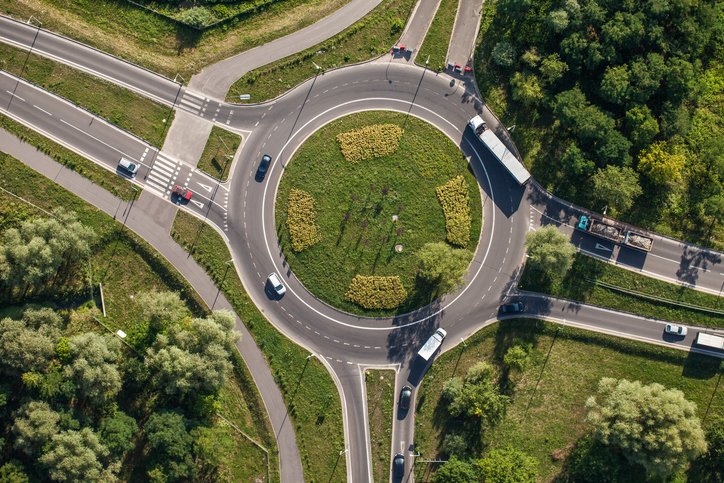
Roundabout Safety: Proven Tips to Avoid Car Accidents in Bonita Springs
The common belief is that the driver already in a roundabout always has the right of way, full stop, so a crash there must be the other person’s fault. Florida law is not that tidy, and the crashes at our Bonita Springs circles rarely sort out that cleanly. Folks come into our Windsor Place office on Bonita Beach Road saying the same thing: “I don’t know what I’m supposed to do at those circles.” The confusion is not a character flaw. The roads are still new to a lot of our drivers, and seasonal traffic turns Old 41 into a parade of rental cars from October through April.
Roundabouts really are safer than the four-way intersections they replaced. The research from the Insurance Institute for Highway Safety on roundabout safety is hard to argue with. But “safer” is not “safe,” and the wrecks that do happen at our local circles follow predictable patterns. This piece lays out what Florida law actually says when one lands on you, what we see in practice, and what to do if you are the driver staring at a hood that no longer closes.
Roundabout crashes are usually low-speed, which is exactly why people underestimate them. We represented a client who needed neck surgery after what looked like a minor low-speed collision. The case settled for $175,000. “Low-speed” on the police report does not mean “low-injury” in the MRI.
What Florida law actually says about roundabout crashes
Roundabout collisions are negligence cases. That sounds obvious, but the legal frame matters because three Florida statutes do most of the heavy lifting on the back end.
The first is §768.81, Florida Statutes, the comparative negligence statute. Since the 2023 tort reform, Florida is a modified comparative negligence state. In plain English: if a jury puts you at fifty-one percent or more of the fault for the crash, you recover nothing, full stop. If you are fifty percent or less, your damages are reduced by your share. At a roundabout, where fault often gets carved up between an entering driver, a circulating driver, and sometimes a third car that braked hard, that percentage fight is the whole ball game.
The second is §95.11(4)(a), Florida Statutes, the statute of limitations. Before the 2023 changes, you had four years to file a negligence lawsuit. Now you have two. In plain English: from the date of the roundabout crash, the courthouse door closes in twenty-four months. I have seen people lose viable cases because they thought they still had three years and showed up at month twenty-eight.
The third is §627.736, Florida Statutes, Personal Injury Protection. Every Florida-registered car carries ten thousand dollars in PIP. It pays your initial medical bills and a portion of lost wages no matter who caused the crash. There is a catch: you generally have to be seen by a qualified medical provider within fourteen days of the crash to keep that coverage available. Miss the fourteen-day window and PIP is gone. People walk away from a low-speed circle bump feeling fine on a Tuesday, wake up Wednesday with a stiff neck that becomes a herniated disc, and then call us at day twenty wondering why their PIP is closed.
One more worth knowing: §627.727 governs Uninsured Motorist coverage. Florida does not require drivers to carry bodily injury liability, and a real percentage of our drivers carry nothing beyond the PIP minimum. If the other driver at the roundabout has no liability coverage, your own UM is often the only meaningful pot of money. Buy it. Stack it if you can afford to.
The scenarios we actually see at Bonita Springs roundabouts
If I sat in our conference room and listed every roundabout case our firm has handled in the last few years, they would fit into about five buckets.
- The failure-to-yield entry. Driver A is already circulating. Driver B rolls up to the yield line, glances left, decides the gap is wide enough, and is wrong. This is the single most common pattern at Old 41 and Terry Street and at the Logan Boulevard circle over in Collier County. It is almost always Driver B’s fault under Florida law.
- The over-cautious stop. Driver A reaches the yield line with a clear circle in front of her and stops anyway because she does not trust the geometry. Driver C, behind her, was already committed to rolling through and rear-ends her. Florida law usually puts the rear driver at fault, but a roundabout stop with no traffic in the circle can shift some percentage onto the front driver. This is exactly the percentage fight §768.81 was written for.
- Lane-choice errors at the two-lane circles. At a multi-lane roundabout, the inside lane is for going past the next exit; the outside lane is for the next exit. Drivers pick the wrong lane, then cut across to make their exit, and clip the car beside them. These cases get messy because both drivers are usually doing something wrong.
- No-signal exits. Driver A is circulating. Driver B is at the yield line waiting. Driver A is actually exiting at B’s entrance but never hits a turn signal. B waits, gets honked at by the car behind him, finally pulls out, and Driver A (who turned out to be going around again) t-bones him.
- Pedestrians and bicycles at the crosswalks. The crosswalks at the approaches are where it gets dangerous for non-drivers. A car treating the yield as a stop will sometimes accelerate hard once the circle clears, right through a crosswalk with a person in it. These cases tend to be the most serious by far.
The common thread is that nobody at a roundabout crash is paying attention to the right thing. The driver is watching the car in the circle when they should be watching the car already entering it, or the pedestrian on the corner, or the cyclist who has the right to use the lane.
Roundabout cases — why these cases are harder than they look
From a recovery standpoint, the difficulty in a roundabout case is not the medicine. It is the fault narrative. At a four-way intersection with a light, the camera footage usually decides the case in five minutes. At a roundabout there is no light to run, so liability turns on speed, yielding behavior, and who was in the circle first by how many car lengths. That requires reconstruction.
We have used reconstruction engineers on Bonita Springs roundabout cases who spend a full day at the actual circle, mapping sight lines, measuring entry angles, and pulling dashcam from nearby businesses. On one case off Imperial Parkway, the difference between fifty-one percent fault and forty-nine percent fault (meaning the difference between zero recovery and a real settlement) came down to two seconds of cell-phone video a witness had shot from a parking lot. The reconstruction work on cases like that is where having a firm that has done this for thirty years matters. You are not learning the playbook on someone’s case.
The second complication is the local geography. The Old 41 and Terry Street roundabout has its own personality. So does the one at the south end of Bonita Bay, and the smaller circles inside Spanish Wells and Pelican Landing. Each has different sight-line problems, different signage history, and different crash patterns the City and the County have been quietly tracking. Knowing which way each circle’s confusion tends to break is part of how cases get evaluated.
A third issue is the seasonal driver. From November through April, a large share of the cars in any of our Bonita circles are rental cars, second-home owners, or visitors who have never seen a roundabout outside of Europe. That is not legal fault on the firm-defense side, but it does mean witness testimony often comes from a driver who lives in Indiana and will be gone in three weeks. We move on those cases fast for that reason.
A Old 41 client we represented
One of my earlier cases is one I still think about. A six-year-old boy chased a ball into the road. The car that hit him was not going through a roundabout, but the principle is the same one any parent on Bonita Beach Road or in the residential corridors off Old 41 should know: small children and traffic do not mix the way adults assume they do. He was hit so hard he came out of his shoes. He landed on his head. He spent months in the hospital and walked out, eventually, with moderate permanent brain damage.
His mother was a single parent. I would drive over to the hospital to visit him, and we would bring food on the days when she could not think about cooking. That is the part of this work the brochures never mention. You sit with a family for months while the case quietly moves in the background.
The case settled at the at-fault driver’s policy limit. Because the client was a minor, the settlement could not just be deposited in a bank account. Florida requires what is called a minor-court settlement: in plain English, a Florida judge has to review and approve the deal, and the money goes into a court-supervised account that the child cannot touch until they turn eighteen. Eleven years later, that now-young-man had enough to pay for college and start a real adult life. He did exactly that.
I tell that case because the law around children and traffic — including the Florida Rule of 6, which says a jury cannot assign any percentage of fault to a child under six — exists for a reason. At a roundabout, where a confused driver is more likely to accelerate through a crosswalk than at a signal-controlled intersection, that protection matters.
What to do if you are in a Bonita Springs roundabout crash
This is the part of any blog where most lawyers paste a generic action list. I am going to give you the list our firm actually walks clients through, because the generic version misses what matters.
- Stay in your car if it is in the circle and traffic is still moving. Getting out to exchange information in the middle of a live roundabout is how secondary crashes happen. Pull through to the next exit if the car is drivable. If it is not, turn your hazards on and wait for police.
- Call 911 and ask for both police and EMS, even if you think you are fine. Under §316.066 you have to make a report on anything beyond a fender scrape. The crash report is the document everything else gets built on.
- Photograph the circle, not just the cars. Most clients show up with twelve photos of bumper damage and none of the yield line, the approach signs, or the lane markings. The lane markings are often the case. Walk around the circle and shoot from each entrance.
- Get witness names before they leave. I have noticed that the most useful witnesses at a roundabout are usually the drivers behind you, who saw the whole approach. They are also the drivers most likely to leave the second the wreckers arrive. Ask for a phone number on a slip of paper. Most people will give it.
- See a doctor inside fourteen days. Even if you feel fine. The PIP statute is unforgiving on this point. Soft-tissue injuries from low-speed circle crashes have a way of waking up on day three.
- Do not give a recorded statement to the other driver’s insurance company. They will call within seventy-two hours. They are friendly. They are not your friend. Anything you say will be used to argue your percentage of fault under §768.81. Tell them you will follow up after you have spoken to a lawyer.
- Save your dashcam footage immediately. Most dashcams overwrite on a loop. If you have one, pull the card the day of the crash. We have seen good cases die because the dashcam quietly recorded over itself for two weeks before anyone thought to check.
Key Takeaways
- At a Florida roundabout, the driver already in the circle has the right of way; the driver at the yield line must yield to traffic coming from the left.
- Under §95.11(4)(a), you have two years from the crash date to file a negligence lawsuit, not four, since the 2023 tort reform.
- Under §768.81, if a jury finds you more than fifty percent at fault for the roundabout crash, you recover nothing; at fifty percent or less, your share reduces what you collect.
- Under §627.736, PIP gives you ten thousand dollars of no-fault medical coverage, but only if you are seen by a qualified provider within fourteen days of the crash.
- Roundabout fault fights almost always come down to reconstruction, sight lines, and timing: preserve photos, witness numbers, and dashcam footage on the day of the crash.
Frequently Asked Questions
Q1. Who has the right of way in a Florida roundabout?
Drivers already inside the circle have the right of way. If you are approaching from an entrance, you must yield to traffic coming from your left before you enter. Treating the yield line like a stop sign causes most of the rear-end crashes we see at Bonita Springs roundabouts.
Q2. How long do I have to file a Florida car accident lawsuit after a roundabout crash?
Under §95.11(4)(a), Florida Statutes, you have two years from the date of the crash to file a negligence lawsuit. That is a shorter window than the four-year rule that existed before the 2023 tort reform, and it applies to most roundabout collisions.
Q3. What if I was partly at fault for a roundabout crash in Bonita Springs?
Florida is now a modified comparative negligence state under §768.81. If a jury finds you more than fifty percent at fault, you recover nothing. If you are fifty percent or less at fault, your recovery is reduced by your share. Sorting out fault at a roundabout often comes down to who entered the circle first and at what speed.
Q4. Does PIP cover my injuries from a roundabout accident?
Yes. Under §627.736, Personal Injury Protection pays up to ten thousand dollars in medical bills and lost wages regardless of who caused the crash. You generally need to be seen by a qualified medical provider within fourteen days of the crash to keep that coverage available.
Q5. Do I have to make a crash report after a roundabout accident?
Under §316.066, you must report a crash that involves injury, death, or apparent property damage of at least five hundred dollars. Even when damage looks minor, call the Bonita Springs Police or the Lee County Sheriff. The crash report becomes the backbone of any later claim.
Talk to our firm before you talk to their insurance company
If you or someone in your family was hurt at a roundabout in Bonita Springs, Fort Myers, Estero, or anywhere else in Lee or Collier County, call our office at 239-992-8259 for a free consultation. We will pull the crash report, look at the circle on a map with you, and tell you straight whether there is a case to pursue. There is no fee unless we recover for you.
About the Author
Founded by David B. Pittman, Esq., Pittman Law Firm, P.L. has handled personal injury work from the firm’s Windsor Place office on Bonita Beach Road for more than thirty years, with a sustained focus on serious-injury auto and complex-liability cases. Bonita Springs is home for the firm, and most of its child-pedestrian, premises, and family-injury cases come from the residential corridors off Old 41 and Imperial Parkway, the school zones around the Bonita Beach Road corridor, and the surrounding Lee County neighborhoods.
David’s undergraduate years were at The Citadel, The Military College of South Carolina; his legal education at the University of South Carolina School of Law. AV-Preeminent at Martindale-Hubbell; member of the Multi-Million Dollar Advocates Forum.
David has held a Florida real estate broker license for twenty-five years, a credential that shapes how the firm reads the property side of premises cases. The firm handles personal injury cases across Lee and Collier Counties, serving Fort Myers, Bonita Springs, Naples, Cape Coral, Estero, and Lehigh Acres, with offices at Windsor Place in Bonita Springs (main) and Fort Myers (satellite). Call 239-992-8259 for a free consultation.
This article is for general information about Florida personal injury law and is not legal advice. Reading it does not create an attorney-client relationship with Pittman Law Firm, P.L. Every case turns on its own facts. The hiring of a lawyer is an important decision that should not be based solely on advertising; before you decide, ask us to send you free written information about our qualifications and experience.