

U.S. 41 / Tamiami Trail: What Florida Law Says When You’re Hurt on America’s Second-Deadliest Road
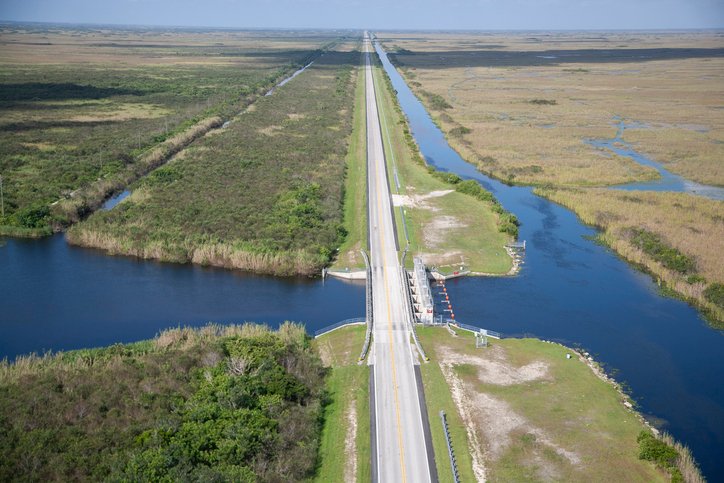
People rarely call our office and lead with “I was in a car wreck.” They lead with the road: “I was on 41, near Corkscrew,” or “I was coming up Tamiami past Pine Ridge.” Naming the spot tells me half the story before they get to the rest. U.S. 41, the Tamiami Trail, runs from Tampa to Miami and threads through the front door of every town we cover, Bonita Springs, Fort Myers, Estero, Naples, and federal and state crash data put it second on the national list of deadliest highways, more than 700 fatal crashes in the past decade.
This post is not another safety-tips listicle. The legacy version of this page on our site was, and Google was right to penalize it. What follows is what Florida law actually says when a U.S. 41 crash lands on your doorstep, what we see on this corridor in practice, and how we work the cases.
I think of a North Naples man who came to us after a head-on crash on one of these corridors. He needed a full hip replacement. The case settled for $275,000. The road did not cause that wreck. A driver did. But the speed and design of these highways is what turns an ordinary mistake into a hip replacement.
What Florida law actually says about a U.S. 41 crash
Three statutes do most of the work in a Tamiami Trail injury case. They are worth understanding in plain English before you ever sign anything an insurance adjuster puts in front of you.
§768.81, Florida Statutes — modified comparative negligence. In 2023 the Legislature changed the rules. Before the reform, you could be 70% at fault and still recover 30% of your damages. Today, if a jury puts you at 51% or more, you recover nothing. On a road like 41 (multi-lane, heavy turning, with frequent rear-end and left-turn collisions), defense lawyers and adjusters spend a lot of energy trying to push your percentage of fault up to that 51% line. The percentage isn’t abstract. It is the case.
§95.11(4)(a) — two-year statute of limitations. Also a casualty of the 2023 reform. Negligence claims that used to enjoy a four-year window now run two years from the date of the crash. Two years sounds like a lot until you watch a traumatic brain injury client spend the first six months in rehabilitation and the next six trying to figure out whether they can go back to work. Then we have a year. Wrongful-death cases get their own two-year clock from the date of death, not the date of the wreck.
§627.736 — Personal Injury Protection (PIP). Florida is a no-fault state, which means $10,000 of your own PIP pays the first round of bills regardless of who caused the crash. It also means you must see a doctor within fourteen days, or PIP locks you out. I’ve watched people lose access to that $10,000 over a missed two-week deadline because they “felt fine” the day after a 45-mph rear-end on 41. They were not fine.
§627.727 — Uninsured Motorist coverage. On 41 in particular, this is the statute I find myself talking about over and over. A meaningful slice of the drivers on this corridor cannot make you whole even on a clear-liability case: tourist-season renters, out-of-state plates, hit-and-run drivers, drivers carrying the state-minimum bodily injury coverage. Your own UM policy can. Most people who say “I have full coverage” do not, in fact, have full UM coverage, and finding out after the wreck is the wrong time.
§316.066 — the crash report. Florida requires a written report for any injury, any death, any commercial vehicle, or anything that looks like more than $500 in damage. On U.S. 41, given the speeds and the truck volume, I tell people to call law enforcement on any collision. The report becomes the spine of every claim that follows.
The five U.S. 41 scenarios we actually see in our office
After thirty years of these cases, the patterns on the Trail are predictable. Here is what comes through our door:
- Rear-end at a signal. The single most common 41 case. Estero Parkway, Corkscrew, Pine Ridge, Bonita Beach Road, Immokalee — six lanes, fast moving, light goes yellow and the lead driver brakes hard. Florida presumes the rear driver at fault, but the presumption is rebuttable, and adjusters know it.
- Left-turn across oncoming. The Williams Road intersection in Estero is the example I use in conversations, but every 41 intersection with a permissive left has produced one of these in our files. The turning driver almost always misjudges the speed of the through-driver coming down a 50-mph straightaway.
- Commercial truck on the I-75 / 41 connector. Trucks coming off I-75 onto 41 to get to a warehouse, a job site, or the Port often do not slow enough for the surface-street rhythm. A semi T-boning a passenger car at 35 mph is a different injury profile than a passenger-car rear-ender.
- Tourist-season sideswipe. November through April our daily traffic volume jumps roughly 20-25%. Out-of-state drivers, unfamiliar with the lane structure on 41 and with how aggressive the local right-of-way ethic is, drift into the next lane during a turn or a merge.
- Pedestrian or cyclist struck mid-block. Crossings are scarce on long stretches of 41, lighting is uneven after dark, and people on foot make the rational decision to cross where they actually need to be rather than walk a quarter mile to a signal. The driver almost never sees them in time.
Each of these has a different liability story, a different insurance posture, and a different settlement value. Treating them as a single category (the generic “U.S. 41 car wreck”) is how cases get under-valued.
Why U.S. 41 cases are harder than they look
People assume a clear-liability rear-end on a six-lane state highway is a simple file. It is almost never simple. Three reasons:
Comparative-fault arithmetic after 2023. The defense’s first move is to argue you were following too closely, distracted, or speeding. On a clear video, that goes nowhere. On a no-video crash, with two drivers’ competing statements and a witness who saw “a flash,” that argument can move your percentage from 0% to 25% to 40% in a hurry. The 2023 reform raised the stakes on every percentage point.
Layered insurance. A serious 41 case is rarely one policy against one policy. There is your PIP, your UM, the at-fault driver’s bodily injury liability, possibly an umbrella, possibly a commercial policy if the other vehicle was on the clock for an employer, possibly a rideshare policy in its peculiar three-period structure. We have had cases where the recovery came almost entirely off a policy the client did not know existed.
Medical causation on traumatic brain injury and soft-tissue. The signature 41 injuries (TBI from a high-speed rear-end, multi-level disc injuries, rib fractures from a side impact) all involve defense doctors trying to attribute the symptoms to “pre-existing degenerative changes.” For TBI in particular, you need a neuropsychological consultant willing to do real cognitive testing and write down what they find. That is not a witness you hire two weeks before trial.
A truck case out of Naples
A driver in our office was eastbound on Immokalee Road in Naples, in the inside lane, with a green light. A commercial truck coming the opposite direction made a left turn across her path and T-boned the driver’s side of her car. The impact was hard enough that the airbags fired and she lost consciousness at the scene.
The hospital diagnosed a traumatic brain injury and multiple rib fractures. For the first several weeks she was, in her own words, “not herself” — short-term memory gaps, word-finding trouble, headaches that would not lift. The carrier’s first move was the one I expect on a TBI case: imaging looked “unremarkable,” therefore there was no real brain injury, therefore the case was worth the cost of an ER visit and a chiropractic course.
What changed the trajectory was the medical workup. The testing documented, in writing, what her family already knew. We paired that with statements from her supervisor about the changes in her job performance after the wreck. The case settled in the multi-millions in the weeks before trial. The number on the page was nowhere near the carrier’s first offer.
The lesson I take from cases like this, and I tell every TBI client some version of it, is that a brain injury that does not show up on a CT scan can still be real, still be permanent, and still be worth what a real one is worth, if it is documented properly and early.
What to do if you are hit on U.S. 41
Some of this list is borrowed from cases I wish I had been able to do more with. Specific, in order:
- Call law enforcement. Always. A 41 crash with no police report is a 41 crash where the adjuster gets to write the narrative. Don’t accept “let’s just exchange info.”
- See a doctor within fourteen days. Not because you “feel” injured. It is because §627.736 starts the PIP clock the day of the wreck and slams it shut at day fourteen. Walk-in clinics count. Urgent care counts. ER counts.
- Photograph the scene before vehicles move, if you safely can. Lane position, signal phase, debris field. On a 41 intersection wreck, the debris field tells the story of who hit whom and at what angle.
- Get the names of independent witnesses. Not just the drivers — the person in the next car over who saw the light. On a six-lane road, witnesses scatter within ninety seconds.
- Do not give a recorded statement to the other driver’s carrier. They will call within forty-eight hours. They will sound friendly. They are working a file against you. Florida law does not require you to give that statement; PIP only requires you to cooperate with your own carrier.
- Pull your own declarations page. Specifically look for UM and the stacked-vs-non-stacked election. Most people are surprised by what they find.
- Save the gear and the vehicle. Don’t let the totaled car go to salvage until somebody has photographed the airbag deployment, the seat position, and the damage profile. On a TBI case in particular, the vehicle is evidence.
Key Takeaways
- Florida’s 2023 comparative-fault reform means 51% at-fault equals zero recovery; your percentage is the case, not a footnote to it.
- The negligence statute of limitations is now two years (§95.11(4)(a)), down from four. Don’t sit on a claim.
- PIP gives you $10,000 of medical coverage regardless of fault — but only if you see a doctor within fourteen days of the crash.
- Uninsured Motorist coverage (§627.727) is the policy that actually protects you on a tourist-season hit-and-run; check your declarations page before you need it.
- The signature U.S. 41 injuries (traumatic brain injury, multi-level disc, rib fractures from a side impact) are won or lost on early, careful medical documentation, not on closing argument.
Frequently Asked Questions
Q1. If I’m rear-ended on U.S. 41, is the rear driver always at fault?
Florida treats the rear driver as presumptively at fault, but the presumption is rebuttable — a sudden unexplained stop, a brake-light failure on the lead car, or a third car pushing the rear driver from behind can shift the picture. Since 2023, if a jury puts you at 51% or more, you recover nothing, so the percentage matters from day one.
Q2. How long do I have to file a U.S. 41 crash injury claim in Florida?
Two years from the date of the crash for most negligence claims, under §95.11(4)(a) as amended in 2023. Before the 2023 reform it was four years. Wrongful-death cases also run two years, but from the date of death, not the date of the crash.
Q3. Does Florida PIP cover me if I’m hurt on the Tamiami Trail?
Yes. Under §627.736, your own auto policy’s $10,000 in Personal Injury Protection pays 80% of reasonable medical bills and 60% of lost wages no matter who caused the crash, as long as you see a doctor within fourteen days. PIP is the floor — it does not pay pain and suffering, and it runs out fast on a serious injury.
Q4. What if the driver who hit me on U.S. 41 has no insurance, or fled the scene?
That is what Uninsured Motorist coverage under §627.727 is for. Your own UM policy treats a hit-and-run or uninsured driver the same way it would treat an insured one — your carrier steps into the shoes of the at-fault driver. If you stacked UM across multiple vehicles on the policy, you may have more coverage than you realize.
Q5. Do I have to file a police report after a Tamiami Trail crash?
Florida law (§316.066) requires a written report any time there is injury, death, or apparent property damage over $500, and for commercial vehicles or hit-and-runs. On U.S. 41, where speeds and traffic volumes are what they are, you should call law enforcement on any collision — the crash report becomes the spine of every later claim.
If You’ve Been Hurt on U.S. 41 — Call Us
If you or someone in your family has been injured in a crash on the Tamiami Trail — anywhere from Bonita Springs through Estero, Fort Myers, or Naples — call our office at 239-992-8259 for a free consultation. There is no fee unless we recover for you. I will sit down with you, walk through your policy, walk through the crash, and tell you plainly what we think the case is worth and what it will take to get there.
About the Author

David B. Pittman, Esq. founded Pittman Law Firm, P.L. and has spent more than thirty years handling personal injury cases across Southwest Florida. The firm represents injured clients across Lee and Collier Counties — from the firm’s main office at Windsor Place on Bonita Beach Road through Fort Myers, Naples, Estero, Cape Coral, and Lehigh Acres — with a particular focus on commercial-vehicle, complex-liability, and serious-injury cases.
David’s background: The Citadel, The Military College of South Carolina for undergraduate; the University of South Carolina School of Law for his JD; an AV-Preeminent rating from Martindale-Hubbell; membership in the Multi-Million Dollar Advocates Forum.
David has held a Florida real estate broker license for twenty-five years, a credential that shapes how the firm reads the property side of premises cases. The firm handles personal injury cases across Lee and Collier Counties, serving Fort Myers, Bonita Springs, Naples, Cape Coral, Estero, and Lehigh Acres, with offices at Windsor Place in Bonita Springs (main) and Fort Myers (satellite). Call 239-992-8259 for a free consultation.
The information on this page is for general information only and is not legal advice for any individual case. Reading this page or contacting our office does not create an attorney-client relationship. This is attorney advertising. Prior results do not guarantee a similar outcome.