

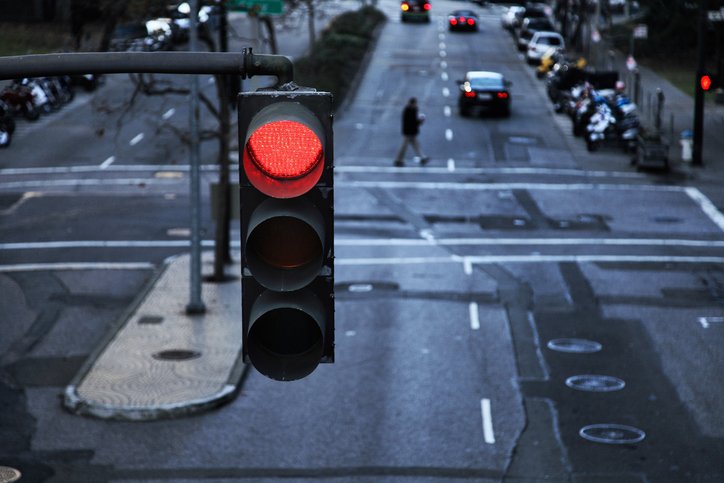
Who Is Liable in a Red Light Accident in Naples?
People assume a red-light crash in Naples is open and shut. The other driver ran the light, so the other driver pays. That assumption is the starting position, not the finish line. Florida moved to a modified comparative negligence system in 2023 under §768.81, and the carrier on the other side will look at every detail of how you entered the intersection — your speed, whether you were on your phone, whether you flinched left into the runner’s path. If they can push five, ten, or twenty percent of the fault onto you, they will try. That is not cynicism. It is the standard playbook, and we see it run every month in Collier County.
This piece walks through what Florida law actually says about red-light fault, the scenarios we keep seeing at intersections along US-41 and Immokalee Road, and the practical reasons these cases are harder than they look on paper.
What Florida law actually says about red-light liability
Three Florida statutes do most of the heavy lifting on a red-light crash claim. None of them are complicated once you cut through the language.
§768.81, Florida Statutes — Modified comparative negligence. Florida switched in 2023 from pure comparative negligence to modified comparative negligence. In plain English, if a jury decides you were more than 50% at fault for your own crash, you recover nothing. At 50% or below, your recovery is reduced by your percentage of fault. So if a jury values your case at $400,000 and assigns you 20% of the fault, you take home $320,000. If they put you at 51%, you take home zero. That single number change is why the other side fights so hard to put fractional fault on the injured driver in red-light cases.
§95.11(4)(a), Florida Statutes — Statute of limitations. For crashes on or after March 24, 2023, you have two years from the date of the crash to file a negligence lawsuit. The pre-reform window was four years. We have already seen people lose viable cases because they assumed they still had the old four-year clock. If you were hurt in a Naples red-light crash, do not sit on it.
§627.736, Florida Statutes — Personal Injury Protection. PIP pays the first $10,000 of medical bills and lost wages no matter who caused the crash, but only if you were seen by a doctor within fourteen days. Miss the fourteen-day window and PIP is gone, which makes that early appointment one of the most important moves you make.
On top of that, §627.727 governs Uninsured/Underinsured Motorist coverage, and §316.066 requires a written crash report whenever there is injury, death, or any vehicle that has to be towed. Both come into play in nearly every red-light file we open.
The five scenarios we see at Naples intersections
Red-light cases sort, in our office, into a handful of repeating patterns. After enough years, you stop being surprised.
- Pure runner. The light has been red for two full seconds and a driver coming the other way blows through it. Liability is clean. The fight is over the value of the injuries, not who was at fault.
- Late-yellow runner. The light turned red while the other driver was already inside the intersection. Florida law says they are not technically running a red, but if they were speeding to beat the yellow, comparative fault is back in play.
- Green-arrow versus red-arrow conflict. Common at the protected left turns along Vanderbilt Beach Road and Pine Ridge Road. Both drivers swear they had the green. Camera footage and witness testimony become everything.
- Right-turn-on-red rolling stop. The right-turning driver never came to a full stop and pulled across the path of a through-vehicle. The carrier will argue the through-driver was speeding. Comparative-fault territory.
- Hit and run. The red-light runner keeps going. The case turns into a UM claim against your own carrier, and your carrier suddenly behaves like the at-fault side. We see this on US-41 north of downtown Naples more than people would guess.
Each of these has its own evidentiary fingerprint. Treating them all the same is one of the easier ways to leave money on the table.
What makes Naples red-light cases harder to prove than they look
The structural problem with a red-light crash is that the only people who saw it for sure are the two drivers, and both of them have an obvious reason to remember it the way that helps them. That puts the case on three pillars.
Independent witnesses. A pedestrian on the corner of 5th Avenue South. A driver in the next lane on Goodlette-Frank Road. The bus driver behind you on Golden Gate Parkway. Witnesses who do not know either party and have no reason to lie are gold. Police officers often write down a name and phone number and move on. If we get involved early, we go back to that witness and lock down a recorded statement before the memory fades.
Video. The City of Naples and Collier County run some intersection cameras, but coverage is uneven. The better source is usually private video, the gas station on the corner, the bank ATM, the strip-mall security camera facing the entrance off Gulf Shore Boulevard. Most of those systems overwrite footage in seven to thirty days. We send preservation letters within a day or two of being hired because waiting a month means the footage is already gone.
Physical evidence. The damage pattern on each vehicle, the position of debris in the intersection, the skid marks or absence of them, and the airbag-control-module data inside modern vehicles all tell a story about speed and angle of impact. A reconstruction engineer can read that story for a jury.
Layer on top of that the 2023 modified-comparative-negligence change, the two-year filing deadline, and the carriers’ standard playbook of pressing for a quick low-ball offer before you know the full medical picture, and a case that looked easy on day one looks a lot more involved by day thirty.
One case that illustrates the longer injury arc
The bite cases are not red-light cases, but I want to share one because it sits in the same category of injury, the kind people assume is straightforward until they are inside it. A child was visiting a neighbor’s home on an ordinary afternoon. The neighbor’s dog was unrestrained in the yard. Without warning, the dog attacked the child and inflicted deep lacerations to the face and neck, what the emergency room classified as a Level 4 to 5 bite.
The medical path was long. Emergency plastic surgery to reduce permanent scarring. A full course of rabies shots, which are an ordeal in themselves. Then months of psychological therapy because the child had developed PTSD, the kind where a fenced yard or a neighbor’s barking dog could trigger a panic response. The visible scarring would never fully resolve. That child would carry the marks of one afternoon for the rest of their life.
Florida’s dog-bite statute is strict liability. The owner is on the hook for damages whether or not the dog had ever bitten anyone before, and whether or not the owner did anything wrong with regard to restraint. We pursued the owner’s homeowner’s policy and built the damages case around the full picture, the surgeries, the scarring, the rabies series, the years of therapy, and the permanent psychological component. The matter resolved in a high-value settlement that funded the child’s continuing reconstructive care and therapy.
I tell that story because the same lesson applies to a Naples red-light crash with a child in the back seat. The visible injury at the scene is rarely the full injury. The full injury shows up in month three, month six, the second surgery, the therapy bills, the scar that does not fade. The settlement that resolves the case in week six leaves all of that on the table.
What to do if you have been hit by a red-light runner in Naples
This is the list I give clients on the first phone call, in the order it actually matters.
- Get checked out within fourteen days. Even if you feel fine. PIP disappears if you skip this, and adrenaline masks soft-tissue and concussion symptoms for days. Urgent care counts. The fourteen-day clock is real.
- Photograph the intersection before you leave, if it is safe. The light cycle, the position of the vehicles, the debris, your damage, their damage, any cameras you can see on nearby buildings. Use your phone’s video so the timestamp is preserved.
- Get every witness’s name and number before the police release them. Officers move people along. Witnesses who walk away without contact information are usually gone for good. If you cannot do it yourself, ask a passenger or a bystander.
- Do not give a recorded statement to the other carrier. They will call within forty-eight hours and they will be friendly. They are looking for a sentence they can use to push fault onto you. Tell them your attorney will be in touch.
- Save the gear and the vehicle. If your car is going to be totaled, the salvage yard will scrap it in days. The airbag module inside that car holds five seconds of pre-crash speed data that can prove the other driver was speeding. We routinely send a preservation letter to the yard within the first week.
- Write down the light cycle while it is fresh. Sit down that night and write what you remember, color of the light when you entered, where the other vehicle came from, what you heard. Memories sharpen for forty-eight hours and then begin to soften. Your own notes from day one are useful months later.
Key Takeaways
- Florida moved to modified comparative negligence in 2023 under §768.81, and a finding of 51% or more fault on the injured driver wipes out the recovery in full.
- The deadline to file a negligence lawsuit dropped from four years to two years under §95.11(4)(a) for crashes on or after March 24, 2023.
- PIP under §627.736 pays the first $10,000 of medical bills regardless of fault, but only if you see a doctor within fourteen days of the crash.
- Private video from gas stations, ATMs, and storefronts near the intersection usually overwrites in seven to thirty days, which is why preservation letters need to go out fast.
- For hit-and-run red-light cases or out-of-coverage drivers, UM coverage under §627.727 is often the largest source of recovery, and the waiver, if any, has to be in writing.
Frequently Asked Questions
Q1. Is the driver who ran the red light automatically at fault in Florida?
Usually, but not always. Florida uses modified comparative negligence under §768.81, so a jury can assign a percentage of fault to more than one driver. The red-light runner almost always carries the largest share, but if the other driver was speeding, distracted, or jumping the green early, the carrier will try to push some fault onto them. If you end up over 50% at fault, you recover nothing.
Q2. What evidence actually decides who ran the red light?
Independent witnesses are the single most useful piece of evidence, followed by intersection camera or nearby business camera footage, the traffic crash report under §316.066, and the physical damage pattern on both vehicles. We move quickly to preserve video because many private cameras overwrite within seven to thirty days.
Q3. How long do I have to file a claim after a Naples red-light crash?
Two years from the date of the crash for most negligence claims under §95.11(4)(a). The 2023 tort reform cut the prior four-year window in half, and the deadline applies to crashes on or after March 24, 2023. Wrongful death claims are a separate two-year clock.
Q4. Does my PIP cover me even if the other driver ran the light?
Yes. Florida PIP under §627.736 pays up to $10,000 of your medical bills and lost wages no matter who caused the crash. You need to be seen by a doctor within fourteen days, or PIP is gone. PIP is the first layer; the at-fault driver’s bodily injury coverage and your UM under §627.727 sit on top of it.
Q5. What if the red-light runner has no insurance or fled the scene?
This is exactly what Uninsured/Underinsured Motorist coverage under §627.727 is for. UM steps into the shoes of the missing or under-insured driver. We see this often with rental cars, out-of-state drivers, and hit-and-run runners. If you were not sure whether you carried UM, look at your declarations page; if it was waived, that waiver has to be in writing.
Talk to our office before you talk to their carrier
If you or someone in your family has been hit by a red-light runner in Naples or anywhere across Collier County, call Pittman Law Firm, P.L. at 239-992-8259 for a free consultation. We will review the police report, the available video sources, and your insurance declarations page, and tell you straight what your case looks like. There is no fee unless we recover for you.
About the Author

Since founding Pittman Law Firm, P.L., David B. Pittman, Esq. has spent more than thirty years representing injured clients in Naples and across Collier County, with a particular focus on commercial-vehicle, complex-liability, and serious-injury cases throughout Lee and Collier Counties. Naples cases run heaviest along US-41, Immokalee Road, Pine Ridge Road, and Vanderbilt Beach Road, and through the older commercial and resort properties along Gulf Shore Boulevard and 5th Avenue South.
David earned his undergraduate degree at The Citadel, The Military College of South Carolina, and his J.D. at the University of South Carolina School of Law. He holds an AV-Preeminent rating from Martindale-Hubbell and is a member of the Multi-Million Dollar Advocates Forum.
David has held a Florida real estate broker license for twenty-five years, a credential that shapes how the firm reads the property side of premises cases. The firm handles personal injury cases across Lee and Collier Counties, serving Fort Myers, Bonita Springs, Naples, Cape Coral, Estero, and Lehigh Acres, with offices at Windsor Place in Bonita Springs (main) and Fort Myers (satellite). Call 239-992-8259 for a free consultation.
Disclaimer: This article is for general information only and is not legal advice. Reading it does not create an attorney-client relationship with Pittman Law Firm, P.L. Every case is different, and outcomes depend on the facts. If you have been injured, contact a Florida attorney to discuss your situation. Attorney advertising.