

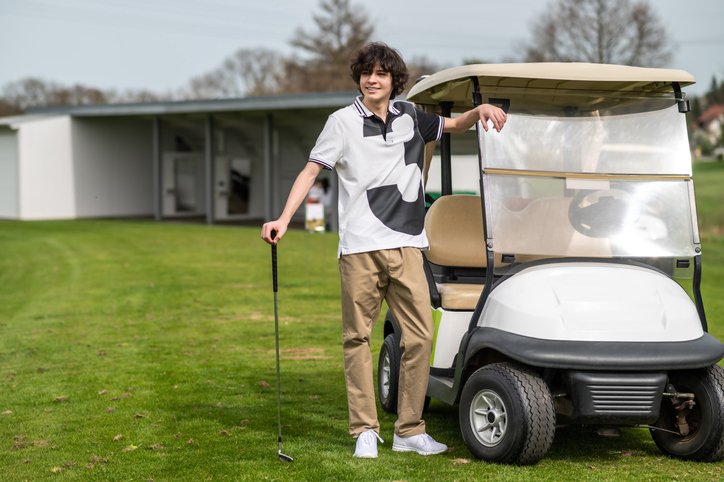
Who Pays When Your Child Causes a Fort Myers Golf Cart Accident?
Florida law treats a golf cart as a dangerous instrumentality, which means the owner can be held financially responsible for the harm a child driver causes — even if the owner was not in the cart, was not at home, and never said the words “you can drive it.” That is a different rule than most Lee County parents expect, and the gap between what families assume and what the law actually says is where most of the financial damage happens.
The rule comes from Florida common law developed in the 1920 case Southern Cotton Oil Co. v. Anderson and extended to golf carts by the Florida Supreme Court in 1984 in Meister v. Fisher. In plain English: express permission makes you liable. So does implied permission — the kind a jury infers from leaving the keys where a teenager who has done this before can reach them. Here is the short version of what that means for your family, and then we will work through the longer one.
What Florida law actually says about minors and golf carts
Three pieces of Florida law do most of the heavy lifting in these cases. None of them are complicated once you take them one at a time.
Florida Statute 316.212 and the 2023 rewrite. Effective October 1, 2023, Florida tightened the rules on who can drive a golf cart on a public road. A driver under eighteen must hold a learner’s permit (available at fifteen) or a regular driver’s license (available at sixteen). Anyone eighteen and over needs a government-issued photo ID. Before the rewrite, a fourteen-year-old could legally drive a golf cart on a public road with no paperwork at all. That is no longer the law. Plenty of Lee County parents still think it is, and that misunderstanding shows up in our intake calls every summer.
Florida Statute 322.09. When a Florida parent signs the application for a minor’s learner’s permit or driver’s license, the parent attaches their own financial responsibility to that minor’s driving. If the teenager later causes a crash because of negligence, the parent is jointly liable. The statute exists because the Legislature decided someone with assets should stand behind a sixteen-year-old behind the wheel.
Florida Statute 322.35. This is the “knowingly permit” statute. If a parent knowingly lets an unlicensed minor drive on a public highway, the parent can be charged and can be sued for the resulting harm. Knowingly permits is a flexible phrase. Courts read it to include the parent who hands the keys over directly, and they also read it to include the parent who leaves the keys on the kitchen counter for a teenager who has done this before.
The dangerous instrumentality doctrine. This one is not a statute. It is a piece of Florida common law that has been around since the 1920 case Southern Cotton Oil Co. v. Anderson. In 1984, in Meister v. Fisher, the Florida Supreme Court applied the doctrine to golf carts. The result, in plain English, is this: if you own a golf cart and you give someone permission to use it, you are liable for the harm they cause behind the wheel, whether or not you were careless in handing it over. Express permission counts. So does implied permission, which is the kind a jury infers from leaving the keys accessible to a teenager you knew would take it.
The Florida Bar Journal has written about this. The flhsmv.gov pages on low-speed vehicles and golf carts walk through the licensing piece. The state’s official page on low-speed vehicles and golf carts is worth reading once you finish here. The statutes themselves are on flsenate.gov.
Five fact patterns that land on our desk every summer
After thirty years of personal injury work, you start to notice that the same fact patterns show up over and over. Five of them account for almost every Fort Myers golf cart case that comes through our door involving a child driver.
- The borrowed-cart-down-the-street scenario. A family in a gated community lets their twelve-year-old run errands in the cart. Another family has been doing the same for two summers. One afternoon, the twelve-year-old clips a pedestrian on a curve near the clubhouse. The dangerous instrumentality doctrine puts the cart’s owner squarely in the lawsuit.
- The keys-on-the-counter scenario. Parents are out at a restaurant on McGregor Boulevard. The fifteen-year-old grabs the cart keys from the kitchen counter and picks up two friends. None of them are licensed. They roll a stop sign on a side street and broadside another cart. The parents never said the word yes. A jury can still find implied permission.
- The community-event scenario. A neighborhood throws a party and a half-dozen golf carts are running back and forth between houses for three hours. A nine-year-old asks to “just drive it to the end of the block.” She loses control going over a curb and a passenger is thrown out. The hosts, the cart owner, and sometimes the parents all become defendants.
- The Daniels Parkway scenario. A teenager who has been driving carts inside a gated community since middle school takes the cart out onto a public road, like Daniels Parkway or Six Mile Cypress Parkway, where carts are not legally permitted at all. A real car hits the cart at forty-five miles an hour. The injuries are catastrophic. Now we are dealing with multiple statutes, criminal exposure, and a coverage fight.
- The rental-fleet scenario. A family renting a place near Pine Island Road for the week rents a cart along with the house. The minor child is allowed by the rental agent to drive on the property. A passenger is hurt. The rental company, the property owner, and the parents are all potentially in the case, and the rental contract usually has a layer of waiver language we have to fight through.
None of these are exotic. Each one is something I have seen, or something I have seen a sibling version of, on Fort Myers streets and inside Lee County communities.
Four complications that make child golf cart cases harder than parents expect
Parents tend to assume one of two things going in. Either they assume the insurance will quietly cover the whole thing, or they assume that because their child “didn’t mean to,” there will not be real consequences. Both assumptions are wrong, and in a serious case both can be financially ruinous.
The first complication is coverage. A standard Florida homeowners policy typically gives some protection for a golf cart while it is being used on the insured’s own residence premises. It often extends a short distance onto private roads inside a gated community. It almost never extends to a public road. The moment your teenager pulls out onto Cleveland Avenue, Summerlin Road, or Daniels Parkway, the homeowners liability piece often drops out, and the auto policy does not pick it up unless the cart is listed and the driver is a permitted operator. That is how families end up personally exposed for hundreds of thousands of dollars of medical care.
The second complication is the damages math. Florida does not put a statutory cap on damages in a private golf cart injury case. A teen driver who causes a head injury to a five-year-old passenger can produce a verdict in the seven figures, with no ceiling. The dangerous instrumentality doctrine attaches that verdict to the owner of the cart.
The third complication is the criminal-civil overlap. If a parent knowingly let an unlicensed minor drive on a public road, a Florida State Attorney can pursue the parent under section 322.35 at the same time we are working through the civil claim with the carrier. A guilty plea or a no-contest plea in the criminal case becomes a piece of evidence in the civil case.
The fourth complication is comparative fault. Florida moved to a modified comparative negligence rule in March 2023. If the injured party is found more than fifty percent at fault, they recover nothing. If they are found, say, twenty percent at fault, their recovery is reduced by twenty percent. In a child driver case, that math gets argued at every step. Was the injured passenger old enough to know better than to ride with a fourteen-year-old at the wheel? Were the parents of the injured child negligent for letting their kid get in the cart? Defense counsel will press every one of those buttons.
One more piece. The Florida “Rule of 6” says a jury is not allowed to assign any percentage of fault to a child under the age of six. If a five-year-old is hurt as a passenger, the comparative-fault arguments aimed at the child cannot stick. If the injured passenger is eight, those arguments can.
A case that shows how the liability framework actually works
This was not a golf cart case, but the way it unfolded is the same way the worst golf cart cases unfold, so I want to use it.
A child, a young one, was over at a neighbor’s house. The neighbors had a dog that was usually kept in a back room when the children were over, and on this particular afternoon the door to that room was left open. The dog came through the kitchen and into the living room, and within a few seconds was on the child’s face and neck. By the time the parents pulled the dog off, the child had deep lacerations along the jaw, the cheek, and the side of the neck. The emergency room sent them straight to a plastic surgeon. The family went home that night with a child wrapped in bandages, a course of rabies shots scheduled out over weeks, and a small human being who had just learned the world is not always safe.
Our office took the case under Florida’s strict liability dog-bite statute, which holds the owner responsible for the harm a dog causes, full stop. We documented every surgical revision, every therapy session, every night the child woke up screaming. The permanent scarring report from the plastic surgeon, paired with the psychological evaluation describing the post-traumatic stress, drove the value. We resolved the matter for an amount that paid for all of the medical care, future plastic surgery the child will need as her face grows, and the long course of therapy.
The reason I bring it up in a golf cart article is the structural similarity. A child, a moment of inattention by an adult, an instrumentality the adult was responsible for, and a permanent injury. Florida treats a golf cart in the hands of a minor very much like a dog with an open door. The owner of the dangerous thing bears the cost.
What to do if your child has caused a golf cart crash in Fort Myers
I get this call a few times each season, and the parents on the other end are almost always panicking. Here is what I tell them, in the order I tell them.
- Get the medical piece right first. Every person in either cart, including your own child, gets evaluated, even the ones who say they feel fine. Children especially will hide pain because they are scared of being in more trouble. Concussion symptoms can take six hours to show up. Internal injuries can take longer.
- Photograph everything before the carts get moved. Both carts from four sides. The scene from a wider angle. Any skid marks, any debris, any landmarks like a stop sign or a curb that explains how the crash happened. If there is a community camera that may have caught it, write down which house it is on.
- Get witnesses on paper. Names and phone numbers, not just first names. A neighbor’s account given the same afternoon is worth ten times what they will remember six weeks later when their statement is being argued about.
- Do not give a recorded statement to any insurance company before you have talked to a lawyer. The recorded statement is not a fact-finding tool. It is built to lock you into language that can be used against your child and against you later.
- Pull your policies. Homeowners, auto, any umbrella, any stand-alone golf cart policy, and any policy your child might be a named insured under, including a non-custodial parent’s policy. Read what they say about minor drivers and about off-premises use. Do not just read the declarations page. Read the actual policy form.
- Write down what happened that day in your own words and put it in a drawer. Not on social media. Not in a text. Your contemporaneous account, dated, will help your lawyer help you later.
- Call our office. You can call us for a free consultation whether your family is the one whose child caused the crash or the one whose child was hurt. Either way, the first call is free and we will tell you straight what the case looks like.
One more piece of practical advice, the kind I have given enough times to know it lands. If you own a golf cart and you have a teenager in the house, put the key on your own keyring and treat it the way you would treat a car key. Do not leave it in the cart. Do not leave it on a hook by the door. The single most common fact pattern in implied-permission cases is a key the teenager did not have to ask for. Make them ask. That one habit has spared more than one Lee County family a six-figure verdict.
Key Takeaways
- Florida treats a golf cart as a dangerous instrumentality, so the owner can be financially responsible for harm a child driver causes, even if the owner was not present.
- Since October 1, 2023, a person under eighteen must hold a learner’s permit or driver’s license to operate a golf cart on a Florida public road.
- A standard homeowners policy usually drops out the moment a golf cart crosses onto a public road like Daniels Parkway, Cleveland Avenue, or McGregor Boulevard.
- Florida does not cap damages in a private golf cart injury case, and the modified comparative negligence rule lets a defendant assign fault to anyone who walked into the situation.
- Keeping the cart key on your own person, the way you would keep a car key, is the single most effective step a Fort Myers parent can take against implied-permission liability.
Frequently Asked Questions
Q1. If my fourteen-year-old takes the golf cart out without permission and hurts someone, am I still on the hook?
In most cases, yes. Florida treats golf carts as dangerous instrumentalities, so the owner of the cart can be financially responsible even when a child took it without express permission. If the keys were accessible, the cart was unlocked, or there was a pattern of unsupervised use, a jury can find that you gave implied permission. The way around this is genuine control, not after-the-fact denials.
Q2. Does my homeowners policy cover a Fort Myers golf cart accident?
Sometimes, but in a narrow way. A standard Florida homeowners policy typically covers a golf cart crash on your own residence premises and may extend a short distance onto private roads inside a gated community. The moment the cart crosses onto a public road like McGregor Boulevard or Daniels Parkway, that coverage usually drops out. You need a stand-alone golf cart policy, an endorsement, or an umbrella to fill that gap.
Q3. What does Florida law require for a minor to drive a golf cart on a public road?
Since October 1, 2023, a person under eighteen must hold either a valid learner’s permit, which a teen can get at fifteen, or a driver’s license, which is sixteen and up, to operate a golf cart on a public road in Florida. Operators eighteen and over must carry a government-issued photo ID. Local governments can layer on stricter rules inside their own jurisdictions.
Q4. Are there damage caps on golf cart injury claims in Florida?
No. Unlike some categories of motor vehicle and government liability claims, Florida does not cap damages in a private golf cart injury case. A bad crash with a child driver can produce a verdict in the millions, which is why owners with real assets need to think about coverage well above the minimum.
Q5. What should I do in the first hour after my child has been in a golf cart crash?
Call 911 and make sure every passenger is medically evaluated, even the ones who say they feel fine. Take photographs of the cart, the scene, and any visible injuries. Get names and phone numbers for every witness. Do not give a recorded statement to any insurer before you have spoken with an attorney. Then call our office and we will walk you through the next steps.
Talk to a Fort Myers golf cart accident attorney
If your family is on either side of a golf cart crash in Fort Myers, Bonita Springs, Naples, Estero, Cape Coral, or Lehigh Acres, call our office at 239-992-8259 for a free consultation. There is no fee unless we recover for you. The first conversation is the most useful one, and it costs you nothing.
About the Author

David B. Pittman, Esq. is the founding attorney of Pittman Law Firm, P.L., handling personal injury cases in Fort Myers and across Lee County since the firm’s founding more than thirty years ago. The firm’s Fort Myers presence handles a steady stream of serious-injury work along the Daniels Parkway, Six Mile Cypress, McGregor Boulevard, Cleveland Avenue, and Summerlin Road corridors, and along I-75 between Estero and Bell Tower, representing injured clients across Lee and Collier Counties, with a particular focus on commercial-vehicle, complex-liability, and serious-injury cases.
David completed his undergraduate degree at The Citadel, The Military College of South Carolina, and his JD at the University of South Carolina School of Law. Martindale-Hubbell rates him AV-Preeminent; the Multi-Million Dollar Advocates Forum counts him as a member.
David has held a Florida real estate broker license for twenty-five years, a credential that shapes how the firm reads the property side of premises cases. The firm handles personal injury cases across Lee and Collier Counties, serving Fort Myers, Bonita Springs, Naples, Cape Coral, Estero, and Lehigh Acres, with offices at Windsor Place in Bonita Springs (main) and Fort Myers (satellite). Call 239-992-8259 for a free consultation.
The information on this website is for general information purposes only. Nothing on this site should be taken as legal advice for any individual case or situation. This information is not intended to create, and receipt or viewing does not constitute, an attorney-client relationship with Pittman Law Firm, P.L. This is an attorney advertisement.