

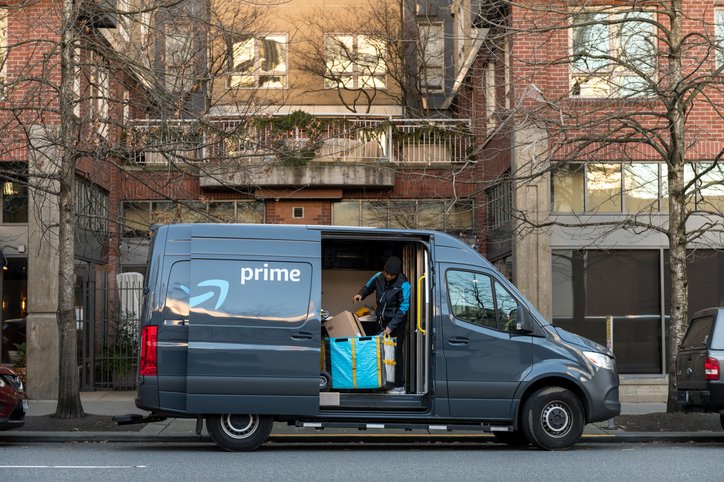
Why Delivery Truck Accidents Are Rising in Fort Myers
Amazon DSP vans, FedEx Ground sprinters, grocery and pharmacy fleets, and the long-haul 18-wheelers that feed the warehouses along Daniels Parkway and out toward I-75 — Fort Myers now has all of them, in volume, and the serious-injury calls coming into our office reflect that shift. The mix has moved away from straight tractor-trailer work into a lot more last-mile delivery, and each of those categories has its own quirks under federal and Florida law.
When a client comes in with photos of an Amazon van or a FedEx Ground sprinter on their phone and asks whether they are suing the driver or the company on the side of the van, the answer is usually both, and sometimes a third party they have not thought of yet. That is what I want to walk through here — what law actually governs these crashes, what we see in practice, and what to do if a commercial vehicle has put you or someone in your family in a Lee Memorial trauma bay.
What Florida law actually says about delivery truck cases
There is no single “delivery truck statute.” A delivery truck case is built out of several layers of law stacked on top of one another, and the layer that wins the case is rarely the one the client expects walking in. Here are the ones I rely on most often.
Florida Statutes §316.520 — unsecured cargo. Florida makes it a moving violation to operate a vehicle on the public roads with a load that is not properly secured against shifting, spilling, blowing, or dropping. You can read the actual text on the Florida Legislature site. In plain English: if a delivery van took a turn too hard and a stack of packages slid into the rear doors hard enough to change how the van handled — or if cargo actually came off the truck and hit another car — that is a statutory violation, and a statutory violation is the kind of evidence that closes cases.
Florida Statutes §316.525 — escape of load. A companion statute, available at the Florida Legislature site, that covers the trucking-specific securement rules — chains, tarps, tie-downs. This one matters most in the bigger 18-wheeler cases that feed the warehouses, less in last-mile delivery, but I have seen it come up when contractors hauled construction materials through residential streets and a piece of pipe rolled off.
49 CFR Part 393 — federal cargo securement. The federal version, available at the FMCSA regulations page. The federal rules are more detailed than the Florida ones and they preempt for any vehicle in interstate commerce, which most long-haul delivery is. In a serious case I plead both.
49 CFR Part 395 — hours of service. Available here. This is the rule that limits how long a commercial driver can be behind the wheel without rest. It is the single most-violated regulation I run into. The electronic logs are now required, and the logs either show the violation or they show that the carrier did not require logging — both are useful at trial.
49 CFR Part 396 — inspection and maintenance. Available here. This is the rule that requires daily pre-trip inspections and a documented maintenance program. When I see a brake failure or a tire blowout case, the first records request is the Part 396 file — and the gaps in that file are usually the case.
Florida also runs on modified comparative negligence as of the 2023 tort reform. A plaintiff who is found more than 50% at fault recovers nothing. Below 50%, the recovery is reduced by the percentage of fault. That mathematical line is why the defense in every delivery-truck case tries to push some fault onto our client — claiming a sudden lane change, a brake-check, anything to get to 51%. Knowing that the defense will reach for that line is half the reason we build cases the way we do.
Fort Myers delivery-truck crashes — the five fact patterns that keep coming back
If I sort the last several years of delivery-truck calls into buckets, almost every case lands in one of these five.
- The rear-end at the residential stop. A delivery driver pulls up to a house on a side street off McGregor Boulevard or in a Cape Coral subdivision, stops fast, and the car behind cannot react in time. Liability looks like a routine rear-end on paper, but it almost never is — the question is whether the delivery driver signaled, used hazards, or pulled fully off the lane.
- The parking-lot pedestrian. Delivery driver reversing in a strip-mall lot off Cleveland Avenue or near a Publix on Summerlin Road, with the rear-view camera obscured by stacked packages. The pedestrian never registers. We see this one in retirees and in mothers with strollers.
- The intersection T-bone. Driver rushing to make a delivery window blows a yellow at a major intersection — Six Mile Cypress Parkway and Daniels Parkway is a recurring offender — and clips a vehicle coming through on the green. The hours-of-service logs almost always tell the story on these.
- The cargo-shift rollover. A box truck taking the curve on Pine Island Road too fast, unsecured cargo shifts, the load gets unstable, and the truck either tips or runs off the road into another vehicle. §316.520 cases.
- The interstate jackknife. An 18-wheeler on I-75 between Estero and Bell Tower in heavy rain. Worn tires, excessive speed for conditions, and you end up with a multi-vehicle pile-up where the injuries are catastrophic. The case below is one of these.
Why delivery-truck cases are harder to close than they look
From the outside, a delivery-truck case can look like an easy liability call. A van with a corporate logo, a clear-cut rear-end, a hospitalized client. The complications are not in the liability picture — they are in figuring out who actually pays and how quickly the evidence vanishes.
The Amazon DSP structure is the cleanest example. The driver wears an Amazon vest and drives an Amazon-branded van, but the driver is employed by a small local company called a Delivery Service Partner that Amazon contracts with. Amazon will tell you, often loudly, that the driver is not their employee. That is technically accurate and substantively misleading — Amazon dictates the route, the package count, the delivery window, the in-van surveillance, and the bonus structure. A well-built case names the DSP and Amazon both, and discovers Amazon’s actual operational control during depositions. FedEx Ground works the same way. UPS does not, because UPS drivers are direct employees, which is why those cases settle differently.
The other hard part is evidence preservation. Modern delivery vans carry an ECM that records speed, brake application, throttle position, and steering input in the seconds before a crash. They carry forward-facing and driver-facing cameras with audio. They carry GPS data accurate to the second. None of that is volunteered. All of it is overwritten on a rolling cycle if no one demands preservation. The spoliation letter we send in the first week of a case is not boilerplate — it lists every category we expect them to preserve, with the regulatory citation underneath, and if a single category goes missing after that letter, that becomes its own argument at trial.
How we handled a Fort Myers truck case
One I think about often — an 18-wheeler jackknifed across three lanes of I-75 near Alico Road in the kind of afternoon downpour you get in Fort Myers in late summer. Our client was in the passenger compartment of a sedan that ended up pinned against the guardrail. Multiple rib fractures and a punctured lung that required a chest tube and an extended stay in the trauma unit at Lee Memorial, followed by months of respiratory therapy.
The carrier’s first move was the standard one — argue that the rain was an act of God and that nobody could have stopped in those conditions. The 49 CFR Part 396 records told a different story. The tires on the drive axle were below the federal tread depth minimum, and the carrier’s own inspection sheet had been signed off as compliant the morning of the crash by a mechanic who, as it turned out, had not physically been at that yard that day. The Part 395 logs showed the driver had been on duty seventeen hours in the prior twenty-four. None of that was hard to prove once we had the records — the hard part was getting the records before the carrier had a chance to clean them up.
By the time we sat down with the carrier and the carrier’s umbrella insurer to talk numbers, we had the federal violations stacked on the desk and the medical bills documented to the penny. The case resolved at $1.8 million. The client is back to work. He still has scarring on the lung and probably always will, but the household is whole financially.
What to do if you have been hit by a delivery truck
Action lists are dangerous in legal writing because every situation is different. With that caveat, here is what I tell people who call us in the first hours after a delivery-truck crash, in roughly the order it matters.
- Photograph the van and the driver’s vest before they leave the scene. Get the DOT number on the truck, get the company name on the vest, get the van’s vehicle ID. If it is an Amazon van, photograph the DSP name on the driver’s badge if you can. Two minutes of phone camera work now saves us weeks of discovery later.
- Decline to give a recorded statement to the carrier’s adjuster. They will call within forty-eight hours. They will sound friendly. The statement is going into a file and being mined for inconsistencies six months from now. Tell them politely you have counsel — even if you do not yet — and hang up.
- Save the gear. If you were in your car, do not have the car repaired or scrapped until our reconstruction witness has had a look. The damage pattern on your vehicle is part of the case. If a bicycle or motorcycle was involved, the same rule applies — helmet, jacket, the whole kit.
- Write down what you remember while it is fresh. Time of day, weather, what you saw the driver doing in the seconds before impact, whether the hazards were on, whether the van was fully off the lane. Date the note. Do not post any of it on Facebook or Instagram.
- See a doctor today, not next week. A punctured lung, an internal bleed, or a closed head injury can hide for forty-eight hours and then drop you. The same trip to the hospital that diagnoses the injury also creates the contemporaneous medical record we need to prove causation.
- Call us before the carrier offers a quick settlement. The first offer in a delivery-truck case almost always comes within two weeks and is almost always a fraction of the case’s actual value. Once you sign a release, the case is over.
Key Takeaways
- Delivery-truck cases are usually pursued against both the driver and the company — and frequently against a third party like Amazon or FedEx that controls the route even when the driver is technically a contractor.
- The 2023 amendment to Florida Statutes §95.11 shortened the personal injury statute of limitations to two years. The clock is running from the date of the crash.
- The federal rules at 49 CFR Parts 393, 395, and 396 — cargo securement, hours of service, and maintenance — are where most delivery-truck cases are actually won.
- ECM data, dashcam footage, and driver logs disappear on rolling overwrite cycles. A spoliation preservation letter has to go out the same week you retain counsel.
- Decline the recorded statement, see a doctor the same day, photograph the van and the vest at the scene, and do not sign any release the carrier sends in the first weeks.
Frequently Asked Questions
Q1. Who can I sue after a delivery truck crash in Fort Myers — the driver, the company, or both?
Usually both, and sometimes more. If the driver was on the clock, the employer is on the hook for the driver’s negligence. If the truck was leased, the leasing company may be in. If the driver was an independent contractor — common with Amazon DSPs and FedEx Ground — Amazon or FedEx may still be liable depending on how they controlled the route, the schedule, and the equipment. We file early and name everyone with a plausible role until discovery sorts it out.
Q2. How long do I have to file a lawsuit after a delivery truck crash in Florida?
Two years from the date of the crash for most personal injury claims, under the 2023 amendment to Florida Statutes §95.11. That clock is shorter than people remember — it used to be four years. If a death is involved it is still two years. If a government vehicle is involved there are pre-suit notice requirements that come due even sooner. Call sooner rather than later.
Q3. What evidence disappears first in a delivery truck case?
The electronic control module data, the dashcam footage, the driver’s hours-of-service logs, and the maintenance records. Most carriers overwrite dashcam footage on a 7 to 30 day rolling cycle. We send a spoliation letter the same week we are retained, listing every category of record we expect them to preserve under 49 CFR Parts 390 through 396. Anything they destroy after that letter becomes its own argument at trial.
Q4. Does it matter if the delivery driver was using a personal vehicle?
Less than people think. If the driver was working a delivery route when the crash happened — even in their own car, even with their own insurance — the company that hired them usually has commercial coverage that sits on top. The Florida personal auto policy on the driver’s car is almost always too small for a serious-injury case. The real recovery is at the company level.
Q5. What does a delivery truck case typically settle for in Southwest Florida?
It depends entirely on the injury, the liability picture, and whether federal regulations were violated. We have resolved jackknife and rear-end cases involving commercial vehicles in the range of $1 to $2 million when the medical record is serious and the hours-of-service or maintenance violations are documented. No two cases are identical. Anyone quoting you a number before reading the medical records and the ECM data is guessing.
If a delivery truck has hurt you, talk to us
If you or a family member has been hit by a delivery van, a box truck, or an 18-wheeler anywhere in Fort Myers, Bonita Springs, Naples, or the surrounding counties, I would like to hear what happened before the carrier’s adjuster gets to you. Call our office at 239-992-8259 for a free consultation. There is no fee unless we recover for you.
About the Author

Personal injury is the focus of David B. Pittman, Esq.’s practice in Fort Myers and across Lee County, and has been since he founded Pittman Law Firm, P.L. more than three decades ago, with a sustained focus on commercial-vehicle, FMCSA-regulated, and serious-injury cases. The firm’s Fort Myers presence handles a steady stream of serious-injury work along the Daniels Parkway, Six Mile Cypress, McGregor Boulevard, Cleveland Avenue, and Summerlin Road corridors, and along I-75 between Estero and Bell Tower.
Two schools made the lawyer: The Citadel, The Military College of South Carolina, and the University of South Carolina School of Law. The recognition followed: AV-Preeminent at Martindale-Hubbell, membership in the Multi-Million Dollar Advocates Forum.
David has held a Florida real estate broker license for twenty-five years, a credential that shapes how the firm reads the property side of premises cases. The firm handles personal injury cases across Lee and Collier Counties, serving Fort Myers, Bonita Springs, Naples, Cape Coral, Estero, and Lehigh Acres, with offices at Windsor Place in Bonita Springs (main) and Fort Myers (satellite). Call 239-992-8259 for a free consultation.
Disclaimer: This article is for general information about Florida personal injury law and is not legal advice. Reading it does not create an attorney-client relationship with Pittman Law Firm, P.L. Every case turns on its own facts. If you have been injured, talk to a Florida-licensed attorney about your situation. Attorney advertising.