

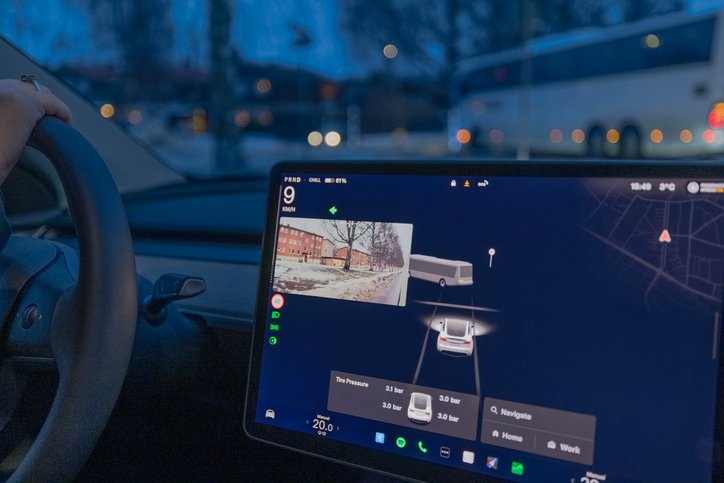
Why Tesla’s Regenerative Braking Causes Rear-End Car Accidents in Florida
The question I get asked about Teslas has changed over the last few years. It used to be, “Is the car safe?” Now it is, “If I get hit by one of these, or if I am driving one and someone hits me, how is the case different?” In my thirty-some years practicing injury law here in Lee and Collier Counties, I can tell you the answer is real, and it shows up in three places: the way the car slows down, the way the brake lights respond to that slowing, and the volume of data the car keeps about everything that happened.
I am not anti-Tesla. I see a lot of these cars on the I-75 corridor through Lee and Collier Counties, and most of the time the drivers behind the wheel are perfectly attentive. The crashes I want to talk about are the ones where regenerative braking, one-pedal driving, and a small but real brake-light delay change the physics of a rear-end collision — and where Florida law gives us tools the old “you hit them from behind, you lose” presumption used to foreclose.
How Tesla crashes are different from ordinary rear-end crashes
Start with the weight. A Model Y or Model X carries roughly 1,000 pounds more than a comparable gas SUV because of the battery pack. More mass at the same speed equals more energy at impact, and that energy has to go somewhere — usually into the back of the car ahead and the necks of the people inside it. We see more cervical spine injuries, more thoracic injuries, and more property damage on the same speed differential.
Then there is the deceleration profile. A Tesla in standard regenerative mode slows down roughly ten times faster than a gas car when the driver lifts off the accelerator. Drivers behind a Tesla calibrate their following distance to what they have always seen — the lead car coasts a bit before brake lights come on — and on a Tesla that assumption is wrong. The car is already shedding speed before the brake lights say so.
How much of a delay? Independent testing puts it at roughly 0.35 seconds on a Model 3, 0.55 seconds on a Model S, and 0.59 seconds on a Model X between the start of meaningful deceleration and brake-light activation. That sounds small. It is not. A driver’s reaction time averages about 1.5 seconds, so half a second is a third of the available reaction window — gone, with no signal to the driver behind.
Phantom braking compounds the problem. NHTSA has logged hundreds of complaints from owners describing the car suddenly slowing for no apparent reason — sometimes near bridges, sometimes near tractor-trailers, sometimes in shadow. If you have driven US-41 / Tamiami Trail at dusk behind a Tesla and seen its taillights flicker for no obvious reason, you have seen the behavior.
The technology-specific question — Autopilot, FSD, and what the car remembers
The single most important fact in a Tesla case is that the car keeps a record. Two records, actually. There is the federally required event data recorder, the same kind of black box every late-model car has, capturing the last few seconds of accelerator, brake, speed, and steering input. And then there is what Tesla calls a collision snapshot — video frames from the exterior cameras, CAN-bus traffic, Autopilot state, regenerative-braking torque levels — uploaded to Tesla’s servers within minutes of the airbag deploying.
That snapshot is gold for a personal injury case, and it is also the most contested piece of evidence in modern auto litigation. Tesla controls the server. Tesla decides what gets imaged, what gets disclosed, and how quickly. We treat it like any other piece of perishable evidence — we send a written preservation letter the same day we are retained, putting Tesla and the other driver’s carrier on notice that the data exists and cannot be overwritten or lost. Florida’s spoliation framework under the Rules of Civil Procedure gives a court real teeth if a party destroys evidence after being told to preserve it, and we use that.
The Autopilot question matters because it changes the legal theory. If the driver had Autopilot or Full Self-Driving engaged at the moment of impact, two things happen. First, the driver is still legally responsible — §768.81, FL Stat., Florida’s comparative negligence rule, treats a driver-assistance system as an aid, not an excuse. The driver is supposed to remain attentive. Second, the manufacturer enters the case. NHTSA’s Standing General Order on driver-assistance crashes has produced years of regulatory findings, and a jury is allowed to hear what NHTSA has concluded about how the system performs.
The product-liability angle — when the manufacturer is a co-defendant
A rear-end Tesla crash is sometimes a single-defendant case — the driver in front lifted off, the car decelerated, the brake lights lagged, the driver behind could not react in time. Driver-versus-driver. But sometimes the design itself is the problem, and Florida product-liability law lets us bring the manufacturer in.
Two statutes do most of the work. §672.314, FL Stat. is Florida’s adoption of the Uniform Commercial Code’s implied warranty of merchantability, which in plain English means that when a manufacturer sells you a car, it has to be fit for the ordinary purpose of being a car — and a car whose brake lights do not reliably signal deceleration arguably is not. §95.031, FL Stat. is the 12-year statute of repose on product-liability claims for new vehicles, which means the clock to file a design-defect case starts ticking from the date the car was first sold, not the date of the crash. On a Tesla, that often gives us plenty of runway. On an older car, it does not.
The reason these cases are worth pursuing — and why I tell clients to think hard before settling with the at-fault driver’s carrier on a quick PIP-plus-policy-limits handshake — is that the manufacturer claim, when it exists, dwarfs the driver claim. The driver’s bodily-injury limits in Florida are often $25,000 or $50,000. The manufacturer’s exposure has no policy limit. If a design contributed to the crash, a settlement with only the driver leaves the larger claim on the table.
How the evidence changed the outcome in one I-75 case
I want to describe a case from our practice that turned on exactly this kind of evidence. The collision happened on I-75 through Lee County — a high-speed multi-vehicle pileup that took the life of a husband and father. The driver who struck him was speeding and, the investigation later confirmed, distracted. The initial narrative from the at-fault driver’s carrier was the usual one: the lead vehicle slowed unpredictably, the rear driver could not react in time, fault should be split.
We did not accept that. I brought in a reconstruction engineering team — not a hired-gun “witness,” just a forensic engineer who has spent a career analyzing high-speed crashes — and they pulled the EDR data from both vehicles and walked the scene. The data told a different story. The defendant was traveling well above the posted limit, his eyes-on-road metric from the phone forensics was poor, and the deceleration our client’s car showed in the final two seconds was consistent with a normal slowdown for traffic, not an erratic event.
The legal theory paired comparative negligence under §768.81 against the at-fault driver with a careful preservation of the product-liability questions raised by the second-impact dynamics. We pursued damages for the emergency medical treatment at the scene, the conscious pain and suffering of our client before he passed, and — the part that matters most to a surviving family — the loss of a husband and father. The case resolved in the seven figures. Money does not fix what happened to that family. It does close the financial chapter so they are not also fighting hospital bills and a mortgage at the same time they are grieving.
What to do after a Tesla crash specifically — data preservation comes first
Most “what to do after a crash” checklists are generic. Tesla cases need a tighter list, because the evidence that wins the case has a short shelf life.
- Do not let the car be repaired or scrapped. The EDR lives in the car. Once a manufacturer-authorized body shop or a salvage yard takes possession and starts work, that data is at risk. Tell the carrier you are not authorizing repair yet.
- Photograph the scene before tow trucks move anything, if you can. Skid marks, debris field, position of the cars relative to lane lines — all of it tells a reconstruction engineer how fast each vehicle was moving and where impact occurred.
- Get the dash-cam footage off the car. Tesla’s Sentry Mode and dash-cam files are stored on a USB drive in the glove box. Pull it. Make two copies. Do not let it stay in the car if the car is going to a body shop.
- Call our office before you call the carrier. The first recorded statement is usually the one that hurts the case. The preservation-of-evidence letter we send Tesla and the other driver’s insurer goes out the same day we are retained.
- See a doctor even if you feel okay. Adrenaline masks neck and back injuries for 24 to 48 hours. PIP coverage in Florida requires treatment within 14 days, so the visit is not just medical, it is procedural.
One more practical note. If you are the family of someone who did not survive the crash, do not let anyone — not the hospital, not the carrier, not the manufacturer — take possession of the vehicle or the phone before a written preservation letter goes out. That is the single thing that goes wrong most often in fatal Tesla cases, and it is fixable with one phone call to us.
Key Takeaways
- Tesla’s regenerative braking decelerates the car roughly ten times faster than a gas vehicle when the driver lifts off the accelerator — and brake lights lag the deceleration by 0.35 to 0.59 seconds depending on model.
- The lag eats roughly a third of the average driver’s reaction window, which is why Tesla rear-end crashes show higher rates and higher severity than the rest of the fleet.
- Florida’s comparative negligence rule under §768.81 still applies, but the rear-driver presumption can be rebutted with EDR data and Tesla’s collision snapshot.
- Product-liability claims against the manufacturer run on a 12-year statute of repose under §95.031 and through the UCC implied warranty under §672.314 — and they often dwarf the driver claim in value.
- Data preservation is the single highest-priority action item after a Tesla crash. Do not let the car be repaired, scrapped, or returned to Tesla before the EDR is imaged and the dash-cam files are copied.
Frequently Asked Questions
Q1. If a Tesla’s regenerative braking slowed the car down before the brake lights came on, does that change who is at fault for a rear-end crash in Florida?
It can. Florida still presumes the rear driver is at fault in a rear-end collision, but that presumption can be rebutted. If we can pull the EDR and Tesla’s collision snapshot and show the lead car decelerated meaningfully before any brake-light signal, that is evidence a jury can weigh under §768.81, FL Stat. — Florida’s comparative negligence rule, which simply means fault gets divided by percentage among everyone who contributed. The rear driver may still carry most of it, but not always all of it.
Q2. Can I sue Tesla itself, or only the other driver?
Both routes are open in the right case. The driver claim runs through ordinary negligence and PIP. A product claim against the manufacturer runs through design-defect law and the UCC implied warranty of merchantability — §672.314, FL Stat., which says goods sold by a merchant must be fit for their ordinary purpose. Florida also has a 12-year statute of repose on product claims for new vehicles under §95.031, FL Stat., so the age of the car matters.
Q3. What data does a Tesla actually keep after a crash?
More than most cars. There is the federally mandated event data recorder, and on top of that Tesla pushes a collision snapshot to its servers — video frames, CAN-bus traffic, accelerator and brake inputs, Autopilot state. That information is the difference between an argument and a proven fact in court, but it has to be preserved fast.
Q4. What should I do in the first 48 hours after a Tesla rear-end crash?
Get medical attention first. Then call our office before you call the carrier. We will send a written preservation-of-evidence letter to Tesla and to the other driver’s insurer the same day, so the EDR and snapshot data are not overwritten or lost. Photograph the vehicles where they sit if you can. Keep the car — do not let it be repaired or scrapped until the data has been imaged.
Q5. Does it matter whether Autopilot or Full Self-Driving was on?
It matters a great deal. NHTSA has open investigations under its Standing General Order on driver-assistance crashes, and those findings are admissible context in a Florida courtroom. If the system was engaged at the moment of impact, the case becomes part driver-negligence and part product. If it was not, the analysis stays on the driver and the regenerative-braking design.
Talk to our office before you talk to the carrier
If you have been rear-ended by a Tesla, or you were driving a Tesla that was struck from behind on I-75, US-41, or anywhere across Lee or Collier County, the first 48 hours decide what evidence survives. I would be glad to walk through what happened with you — what the car remembers, what the other driver’s carrier is going to argue, and whether a product claim belongs alongside the driver claim. Call 239-992-8259 for a free consultation. There is no fee unless we recover for you.
About the Author
Personal injury law has been David B. Pittman‘s full-time work for more than three decades, and Pittman Law Firm, P.L. is the practice he built around it. Out of the firm’s main office at Windsor Place on Bonita Beach Road, and a satellite office in Fort Myers, the firm carries serious-injury auto and product-liability cases for clients across Lee and Collier Counties — from Bonita Springs and Estero up through Fort Myers and Cape Coral, and south into Naples.
On the credential side, David read law at the University of South Carolina School of Law after taking his undergraduate degree at The Citadel, The Military College of South Carolina. Martindale-Hubbell has rated him AV-Preeminent, and he sits as a member of the Multi-Million Dollar Advocates Forum.
David has held a Florida real estate broker license for twenty-five years, a credential that shapes how the firm reads the property side of premises cases. The firm handles personal injury cases across Lee and Collier Counties, serving Fort Myers, Bonita Springs, Naples, Cape Coral, Estero, and Lehigh Acres, with offices at Windsor Place in Bonita Springs (main) and Fort Myers (satellite). Call 239-992-8259 for a free consultation.
The information on this page is general information about Florida personal injury law and is not legal advice for any particular case or situation. Reading it does not create an attorney-client relationship with Pittman Law Firm, P.L. Past results do not guarantee a similar outcome in any other matter. This is attorney advertising.