

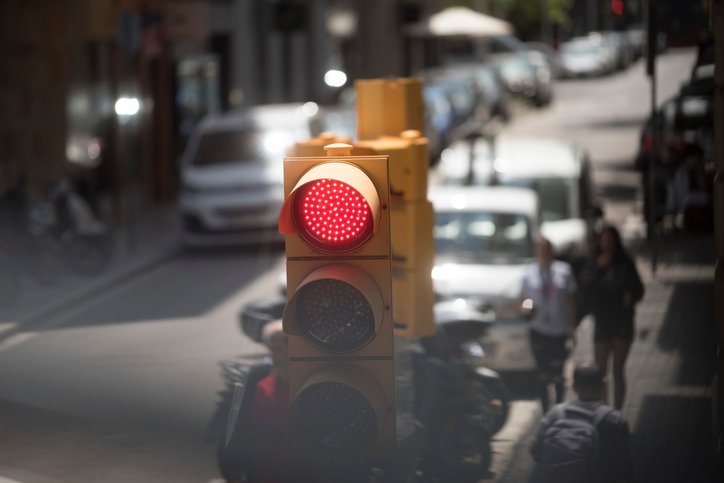
Just Got Rear-Ended at a Red Light? Here’s What to Do Right Now in Bonita Springs
The caller usually leads with the same sentence: “I was just sitting there.” They were stopped at the light at Bonita Beach Road and Old 41. They were waiting to turn off US-41 onto Imperial Parkway. They were idling at the school-zone signal near the Bonita Beach Road corridor. The light was red. Their foot was on the brake. And then a Ford F-150 or a delivery van or a distracted college kid in a Civic put them in the emergency room.
The next forty-eight hours matter more than most people realize. Not because a rear-end case at a red light is complicated in the way a multi-vehicle pileup on I-75 is complicated — most of them are not. They matter because what you do, who you call, and what you write down in those first two days shapes everything the insurance company will say about your claim eight months later.
This is a plain walk-through of what Florida law actually requires after a rear-end crash, the patterns we see over and over in our practice, the parts of these cases that are harder than they look, and the steps we tell our own family members to take when somebody puts them in the back bumper at a red light.
What Florida Law Actually Says About Rear-End Crashes
Five statutes do most of the work in a Bonita Springs rear-end case. Knowing them ahead of time keeps you from getting steered into a bad decision by an adjuster who knows them better than you do.
Crash reporting — §316.066, Florida Statutes. Florida requires a written police report whenever a crash causes injury or apparent property damage. In plain English, if your bumper is cracked or your neck hurts, somebody in a uniform should be writing this up. A driver-exchange-of-information form passed back and forth on the shoulder is not enough.
PIP — §627.736, Florida Statutes. Every Florida driver carries Personal Injury Protection. PIP pays up to $10,000 in medical bills regardless of fault — but only if you see a qualifying medical provider within fourteen days of the crash. Miss that window and the coverage you have been paying for evaporates. Without an Emergency Medical Condition diagnosis, your benefits are capped at $2,500.
Uninsured Motorist — §627.727, Florida Statutes. Florida does not require drivers to carry bodily-injury liability coverage. Read that sentence twice. The driver who hit you may have zero insurance for your injuries. Uninsured Motorist coverage on your own policy is what protects you in that situation, and we cannot recommend it strongly enough — it is some of the cheapest, most useful coverage you can buy.
Statute of limitations — §95.11(4)(a), Florida Statutes. The 2023 tort reform cut the negligence filing window from four years to two. Two years from the date of the crash, not from the date you finish treatment. If your case is not resolved by then, a lawsuit has to be on file or your right to sue is gone.
Comparative negligence — §768.81, Florida Statutes. The same 2023 reform moved Florida from pure to modified comparative negligence. If a jury decides you were more than fifty percent at fault, you take nothing home. In a stopped-at-a-red-light case, the rear driver almost always owns the fault. Almost. The defense will still try to chip percentages off — claiming you stopped short, that your brake lights were out, that you were on your phone. The way you document the scene determines whether those arguments stick.
The rear-end situations that land in our office in Bonita Springs
After thirty years of these cases, the rear-end-at-a-red-light fact pattern breaks down into a handful of repeating shapes. Five we see most often:
- The distracted-phone rear-end. The other driver was looking down. They never braked. The damage to your rear bumper is severe because there were no skid marks ahead of impact. This is the most common version we see at the Bonita Beach Road and Old 41 light.
- The chain-reaction rear-end. You were stopped behind another stopped car. A third driver hits the car behind you, which pushes them into you. Two impacts, two sets of injuries, and a fault picture that needs to be sorted out carefully under §768.81.
- The commercial-vehicle rear-end. A delivery van, landscape trailer, or work truck hits you. Sometimes the driver is on the clock, which opens up a corporate liability policy that is usually much larger than the driver’s personal policy.
- The uninsured / minimum-policy rear-end. The driver who hit you has a $10,000 property-damage policy and no bodily-injury coverage at all. Your own UM policy under §627.727 becomes the case.
- The “soft tissue, walked away” rear-end. You felt fine at the scene. Two mornings later you cannot turn your head to back out of the driveway. These cases get under-treated and under-documented constantly, and they are where the 14-day PIP rule trips people up the most.
Rear-End Cases — Why They Are Harder Than They Look
Most people assume a rear-end claim is a layup. The other driver hit you from behind. They obviously caused it. Why would this ever be hard?
Three reasons, over and over.
First, the injury pattern. Rear-end impacts produce whiplash, cervical-spine injuries, herniated discs, concussion symptoms, and shoulder injuries that develop over days rather than appearing instantly. Adjusters know this. They will press you for a recorded statement in the first seventy-two hours, before you have seen a real doctor, hoping you will say “I feel fine” on tape. That recording follows the case forever.
Second, the medical paperwork. Florida’s no-fault system funnels your treatment through PIP first, and PIP has its own rules about which providers qualify, what an Emergency Medical Condition diagnosis looks like, and how the $10,000 cap actually applies. We have seen good cases fall apart because someone went to an urgent care that did not bill PIP correctly, or because the fourteen-day window closed while the client was waiting on a referral.
Third, the comparative-fault game. Under §768.81 as it now reads, every percentage point the defense can pin on you reduces your recovery. In a rear-end case, the standard moves are: “she slammed on her brakes for no reason,” “his tail lights were out,” “she was reaching for something in the passenger seat.” None of those usually win — but they all chip. Photographs, witness contacts, and a clean crash report shut those arguments down before they start.
A case that shows how rear-end injuries can move through the system
One of the first larger cases I took on, years ago, was a six-year-old boy who chased a ball into the road. He was hit so hard he flew out of his shoes, across the road, and landed on his head. He spent months in the hospital. He came home with moderate permanent brain damage. His mom was a single parent, working, scared, exhausted. I would drive over to the hospital to see him, and on the days she could not think about cooking, we brought food.
The case settled at the policy limit. Because the client was a minor, the settlement had to be approved by a Florida judge — what we call a minor-court settlement — with the money held in a court-supervised account until he turned eighteen. By that birthday, the now-young-man had enough to pay for college and get a real start in life. He did.
I tell that story because the same protective structure shows up in rear-end cases too. When a child is hurt in the back seat of a car somebody plows into at a red light, the recovery is not handled the same way an adult’s claim is. The court steps in. The money is protected. And the work we do in the first weeks — the crash report, the medical documentation, the careful refusal to give a recorded statement — is what gives us something to settle in the first place.
What to Do If You Get Rear-Ended at a Red Light in Bonita Springs
This is the step-by-step we give our own family. Not a generic list — the specific sequence we have used for thirty years.
- Stay in the car until you have looked around. If the crash happened in the middle of the Bonita Beach Road and US-41 intersection, getting out into live traffic is more dangerous than staying buckled in. Look both directions. Then move.
- Turn on your hazards before anything else. Even if you cannot move the car, drivers approaching from behind need to see you. This is the single most useful thing your dashboard does after a crash.
- Call 911 — not the non-emergency line. Lee County dispatchers will route a deputy and, if needed, EMS. Tell them clearly: “I was rear-ended at a red light, I am at [intersection], possible neck and back pain.”
- Photograph everything before the cars move. Both vehicles, all four corners. The intersection from the driver’s seat angle. The traffic signal. Skid marks or lack of them. The other driver’s license plate. The other driver’s insurance card. Wide, medium, close. We have used these photos in mediation more times than I can count.
- Get the names and phone numbers of every witness. The driver in the next lane who saw the whole thing will be gone in three minutes. Walk over before they leave.
- Do not say “I’m fine” to anyone except the paramedic. Not the other driver. Not their adjuster. Not the deputy. “I am not sure yet, my neck is starting to hurt” is accurate, because adrenaline masks injuries for hours.
- See a doctor within seventy-two hours, not fourteen days. The fourteen-day rule is the legal outside limit, not the recommendation. Same-day or next-day urgent care creates a clean medical record tying your injuries to the crash.
- Call your own insurance company within twenty-four hours. Stick to the facts: date, time, intersection, name of the other driver. Do not give a recorded statement. Do not speculate. Do not accept blame.
- Do not give the other driver’s insurance company a recorded statement at all. Not without an attorney. This is the single most common way a strong rear-end case gets weakened in the first two weeks.
- Pull your own policy’s declarations page and check for UM coverage. If the other driver is uninsured or underinsured — which happens more often than people expect in Florida — your UM coverage is what makes you whole.
Key Takeaways
- Call 911 and get a written crash report. Under §316.066, Florida Statutes, a written report is required for any injury or noticeable property damage — and it is the cleanest record of what happened.
- See a doctor within fourteen days — sooner is better. Florida’s PIP statute, §627.736, forfeits your $10,000 in no-fault medical coverage if you miss the fourteen-day window.
- Two years to file suit, not four. Florida’s 2023 tort reform cut §95.11(4)(a) to a two-year window for negligence claims, and the clock starts the day of the crash.
- Photograph everything before the cars move. Vehicle damage from all four corners, the intersection, the signal, skid marks, the other driver’s documents, witness contacts. Wide, medium, close.
- Do not give a recorded statement to the other driver’s insurance company. Not in the first two weeks. Not without talking to an attorney first. Under §768.81’s modified comparative-negligence rule, any percentage of fault assigned to you reduces what you recover.
Frequently Asked Questions
Q1. I was rear-ended at a red light in Bonita Springs and I feel okay. Do I really need to call the police?
Yes. Under §316.066, Florida Statutes, a crash with injury or property damage above $500 has to be reported. Even when you feel fine at the scene, neck and back injuries from a stopped-car rear-end often surface twenty-four to seventy-two hours later. A written crash report from a Lee County deputy or Bonita Springs officer locks in the basic facts before anyone has time to reshape the story for an insurance adjuster.
Q2. How long do I have to file a claim after a rear-end crash in Florida?
Under §95.11(4)(a), Florida Statutes, you have two years from the date of the crash to file a negligence lawsuit. That window dropped from four years to two years in the 2023 tort reform, and it applies to almost every car-accident case in Lee and Collier Counties. Two years sounds like a lot. It is not. PIP paperwork, medical treatment, and adjuster back-and-forth eat the calendar quickly.
Q3. What is the 14-day PIP rule and why does it matter?
Florida’s no-fault statute, §627.736, gives you up to $10,000 in Personal Injury Protection medical coverage regardless of who caused the crash — but only if you see a qualifying medical provider within fourteen days of the wreck. Miss that window and you forfeit the benefits you already paid for. Without an Emergency Medical Condition diagnosis from a qualified provider, your PIP is capped at $2,500.
Q4. The other driver was uninsured. Am I out of luck?
Not necessarily. Florida does not require bodily-injury liability coverage, so a fair number of the drivers we share the road with on US-41 carry only the legal minimum, or nothing at all. Under §627.727, Florida Statutes, your own Uninsured Motorist coverage steps in when the at-fault driver does not have enough insurance to make you whole. UM is a separate policy line — pull your declarations page and confirm you have it.
Q5. Will Florida’s comparative-negligence rule affect my rear-end case?
It can. Under §768.81, Florida Statutes, the 2023 reform shifted Florida from pure to modified comparative negligence. If a jury finds you more than fifty percent at fault, you recover nothing. In a stopped-at-a-red-light rear-end, the lead driver usually carries little or no fault — but insurance defense lawyers still argue you stopped short, your brake lights were out, or you were distracted. The way you document the scene matters.
Talk to Our Office
If you were rear-ended at a red light anywhere in Bonita Springs, Estero, Fort Myers, or Naples, call our office at 239-992-8259 for a free consultation. We have handled these cases for thirty years out of our Windsor Place office on Bonita Beach Road. There is no fee unless we recover for you.
About the Author

David B. Pittman, Esq. runs a thirty-year personal injury practice from the firm’s Windsor Place office on Bonita Beach Road as the founder of Pittman Law Firm, P.L., with a sustained focus on serious-injury auto and complex-liability cases. Bonita Springs is home for the firm, and most of its child-pedestrian, premises, and family-injury cases come from the residential corridors off Old 41 and Imperial Parkway, the school zones around the Bonita Beach Road corridor, and the surrounding Lee County neighborhoods near Pelican Landing, Bonita Bay, and Spanish Wells.
His undergraduate degree is from The Citadel, The Military College of South Carolina; his JD is from the University of South Carolina School of Law. Martindale-Hubbell rates him AV-Preeminent, and he is a member of the Multi-Million Dollar Advocates Forum.
David has held a Florida real estate broker license for twenty-five years, a credential that shapes how the firm reads the property side of premises cases. The firm handles personal injury cases across Lee and Collier Counties, serving Fort Myers, Bonita Springs, Naples, Cape Coral, Estero, and Lehigh Acres, with offices at Windsor Place in Bonita Springs (main) and Fort Myers (satellite). Call 239-992-8259 for a free consultation.
The information on this website is for general information purposes only. Nothing on this site should be taken as legal advice for any individual case or situation. This information is not intended to create, and receipt or viewing does not constitute, an attorney-client relationship with Pittman Law Firm, P.L.