

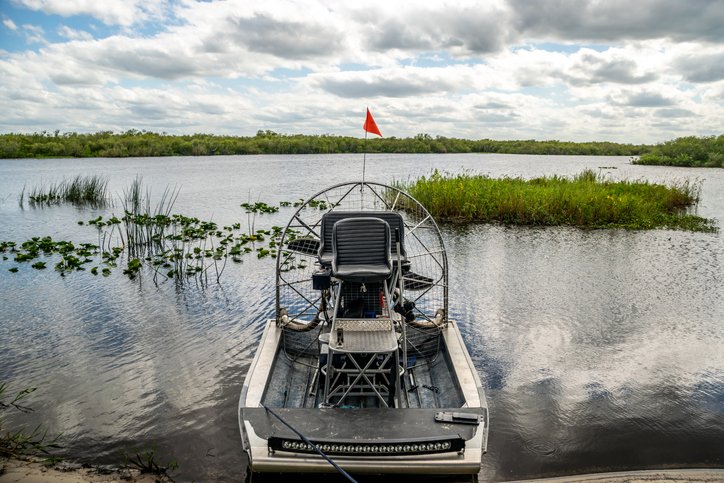
Who Is At Fault In The December Airboat Crash in Naples?
Two commercial airboats. Thirty-three people on board between them. A youth football and cheer team from out of state in the mix — families who got off a plane expecting a Florida adventure and ended up at the Naples-Marco Island hospitals or airlifted up to Gulf Coast Medical Center in Fort Myers. The December collision near Ochopee, off US-41 east of Naples, raised the question our office has been fielding ever since: when something goes wrong on a commercial Everglades tour, who is legally responsible?
I am not going to pretend I know exactly what happened on the water that afternoon. The Florida Fish and Wildlife Conservation Commission is still working that file, and I have learned over thirty years not to talk in absolutes until a final report is on the desk. What I can do is walk through what Florida law actually says, what we see at our office when these tour cases land here, and where the real fault lines tend to fall.
What Florida law actually says about commercial airboat liability
An airboat tour out of a Collier County dock is a commercial passenger operation. The captain is being paid. The company is being paid. That changes the duty of care the operator owes to the people sitting on those bench seats, and it changes how a court looks at the case if something goes wrong.
Three pieces of Florida law do most of the heavy lifting in these cases:
- §768.81, Florida Statutes — modified comparative negligence. Florida apportions fault by percentage among everyone who contributed to the crash. Since the 2023 reform, if you are found more than 50% at fault, you recover nothing. If you are at or below 50%, your award is reduced by your share. In plain English: a paying passenger on a tour boat almost never carries meaningful fault, but the captain, the tour company, a maintenance vendor, and a boat manufacturer can each be brought in and apportioned a piece. Read the statute.
- §95.11(4)(a), Florida Statutes — two-year statute of limitations. Most Florida negligence claims arising after March 24, 2023 must be filed within two years. Wrongful death cases also run on a two-year clock. The old four-year window is gone for new cases. Waiting is the single most common reason a strong airboat case quietly dies. Read the statute.
- §627.736, Florida Statutes — Personal Injury Protection. PIP is the no-fault $10,000 medical bucket on every Florida auto policy. It applies to motor vehicles, not vessels, so PIP almost never picks up an airboat crash. Health insurance pays first, the tour company’s general liability or marine policy is the recovery target, and you should expect a health-insurance lien against any settlement. Read the statute.
One more piece worth knowing: since July 2019, Florida requires commercial airboat captains to carry a photo ID showing they have completed a boater-safety education course, an FWC-approved airboat course, and current CPR and first-aid training. Florida does not, however, require the tour companies themselves to carry liability insurance or to run background checks on captains. That gap is a real problem on the recovery side, and it is one of the first things we check when one of these cases comes in.
How Collier County airboat cases actually break down — four fault lines
Over thirty years of personal injury practice in Lee and Collier Counties, I can tell you the airboat and tour-vessel files break down into a small number of recurring patterns. Knowing which pattern you are in tells you a lot about who is going to end up on the verdict form.
- Captain error — speed, lookout, or distraction. By far the most common. Florida boating-accident data shows the great majority of commercial airboat collisions happen at moderate speeds, between roughly 10 and 40 mph, with operator inattention as the driver. In a head-on between two tour boats in the saw-grass, the captains are usually the first people the investigators want to talk to.
- Company-level negligence — training, supervision, scheduling. When a tour company runs back-to-back trips on a tight schedule, hires a captain with thin hours, or skips the safety-briefing protocol, the company itself becomes a defendant separate from the captain. This is where the deeper insurance coverage usually sits.
- Maintenance and equipment failure. Airboats are loud, hard-used machines. Propeller bolts, steering cables, accelerator linkage, fuel lines — all of it gets a daily beating in the Everglades. A skipped pre-trip inspection, or a maintenance contractor who signed off without actually checking, can put fault on a third party most people would not think to name.
- Manufacturer or vendor defect. A defective propeller guard, a structural failure in the hull, a faulty fuel system — these come up less often, but when they do they reshape the case entirely. The manufacturer’s insurance policy is generally larger than the tour operator’s.
Most real cases sit on more than one of those lines at once. The Wooten’s collision near mile markers 74 and 75 on US-41 in Ochopee — which is the Collier County stretch of Tamiami Trail east of Naples — looks, from the public record so far, like it will involve both captain conduct and company-level questions. I will not speculate beyond that.
Why these airboat cases are more demanding than a standard auto file
An airboat crash case is not a fender-bender on Pine Ridge Road. A few things make it harder than a standard auto file, and you should know them going in.
First, the evidence vanishes fast. There is no permanent skid mark on saw-grass. The boats get pulled back to the dock, washed, sometimes back into service within days. The dash camera, if there even is one, is the company’s property. If you are not on the scene with somebody preserving evidence in the first week, you are working from witness memory and the FWC report.
Second, there are jurisdictional wrinkles. Some Everglades waters fall under federal maritime jurisdiction, which can pull a case into admiralty law instead of straight Florida tort law. That can change the damages model, the warranty analysis, and even the rules on a passenger waiver. We sort that out early because it dictates strategy.
Third, waivers. Every tour company hands you a clipboard at the dock and asks you to sign something. Florida courts do enforce some boating waivers — but not when the conduct rises to gross negligence or recklessness, and not against a minor in many circumstances. A waiver is a fact in the case. It is rarely the end of the case. Do not let an insurance adjuster tell you it is.
Fourth, insurance gaps. The Florida legislature does not require commercial airboat operators to carry liability insurance at all. Most of the reputable Naples and Everglades operators do carry coverage because the marinas and the bigger tour brokers require it, but the limits vary wildly. The first call we make on any of these cases is to nail down the available policies — primary, umbrella, vendor, manufacturer.
The Naples rear-end claim behind this
Most of our serious-injury work is not on the water — it is on the road. The case I want to share here is a rear-end collision on US-41 at Immokalee Road in Naples, because the legal architecture is closer to an airboat crash than people expect, and because the medical arc is one we see again and again.
Our client was stopped at the red light at US-41 and Immokalee Road on a weekday afternoon. The driver behind never lifted off the accelerator — phone in lap, by every indication — and hit our client at roughly 35 miles an hour, hard enough to push our client’s vehicle into the car ahead at the stop bar. Three vehicles, one careless driver, classic chain-reaction.
The injury showed up the way these injuries usually do. Soreness the first night, stiffness the second day, and by the end of the week the radiating pain down one leg that tells an orthopedist the discs are involved. MRI confirmed herniations at L4-L5 and L5-S1. Six months of physical therapy followed, then a series of epidural steroid injections to settle the sciatica down so the client could sit through a workday again.
We resolved the case in a settlement that covered every past medical bill, a reserve for future pain-management injections the treating physician expects this client will need, and full vehicle replacement. The mechanics of that case — multiple potentially-at-fault drivers, a 2023-reform comparative-negligence analysis, a herniated-disc medical workup, an insurance carrier that opened low — are the same mechanics that drive a serious airboat-tour claim. The boat just happens to be in the water.
What to do if you or a family member was hurt on a Naples airboat tour
This is the part where most legal blogs give you a generic ten-point list. I am going to give you the five things that, over thirty years of doing this in Collier County, actually move a tour-boat case.
- Get a medical evaluation the same day, even if you feel fine. Soft-tissue injuries and concussions hide for 24 to 72 hours. A same-day record from the Naples-Marco Island hospital or a walk-in clinic is the single piece of evidence the insurer cannot argue around later.
- Photograph everything before you leave the dock — if you can. Boat numbers, the orange flag and its mast, the muffler setup, the life jackets on board, the bench seating, any visible damage. If you cannot do it that day, send someone within 48 hours.
- Write down the captain’s name, the company’s full name, and the names of every passenger on your boat. Memory degrades fast. Co-passenger witnesses are the heart of these cases.
- Ask the FWC officer on scene for the case number, then request the report once it is filed. The FWC report is the road map. Get it early.
- Do not give a recorded statement to the tour company’s insurer before talking to a lawyer. Adjusters call within the first week, sound friendly, and ask questions designed to lock in answers that hurt the case three months later. There is no benefit to you in that conversation.
One more thing, because I have seen it derail otherwise strong cases. If the tour company offers you a “goodwill” check in the first two weeks — usually a few hundred dollars, framed as a refund — read the release language carefully before you cash it. Some of those checks come stapled to a full release of claims.
Key Takeaways
- An airboat tour is a commercial passenger operation, and the captain plus the tour company owe paying passengers a high duty of care under Florida law.
- Florida’s modified comparative negligence under §768.81 means a paying passenger almost always recovers, but the captain, the company, maintenance vendors, and the boat manufacturer can each be apportioned fault.
- The statute of limitations is now two years from the crash under §95.11(4)(a). Waiting is the most common reason these cases die.
- PIP under §627.736 generally does not apply to vessel crashes; recovery comes from the tour company’s general liability or marine policy, and your health insurance will likely assert a lien.
- A waiver signed at the dock is a fact in the case, not the end of the case — especially where gross negligence or recklessness is in play.
Frequently Asked Questions
Q1. Can a passenger on a Naples airboat tour actually sue the tour company?
Yes. A paid passenger on a commercial airboat is owed a high duty of care by the operator. If the captain, the company’s training, or the company’s maintenance practices contributed to a crash, the tour company can be held responsible in a Florida negligence claim. The fact that you signed a waiver at the dock does not automatically end the case — Florida courts routinely refuse to enforce waivers that try to cover gross negligence or reckless operation.
Q2. How long do I have to file an injury claim after an airboat crash in Florida?
Under the 2023 tort reform, the statute of limitations for most negligence claims in Florida is two years from the date of the incident. Wrongful death cases also generally run on a two-year clock. There are narrow exceptions, but waiting is the most common reason a strong case dies — evidence on an airboat dock disappears quickly.
Q3. Does my health insurance or PIP cover injuries from an airboat crash?
Florida PIP under §627.736 generally covers motor vehicle crashes, not vessels, so PIP usually does not apply to an airboat ride. Your private health insurance will typically pay for treatment up front, and that insurer may later assert a lien against your settlement. The tour company’s general liability or marine policy is usually the main source of recovery.
Q4. What if the other airboat or another passenger was partly at fault?
Florida uses modified comparative negligence under §768.81. After the 2023 reform, if you are found more than 50% at fault you recover nothing. Below that, your award is reduced by your percentage of fault. As a paying passenger you are almost never assigned meaningful fault, but the operators, the companies, and any vendor involved in maintenance can each be brought in and apportioned.
Q5. What should I do right after an airboat crash in the Everglades or near Naples?
Get checked by EMS even if you feel fine, ask whether FWC is responding, write down the names of fellow passengers and crew, photograph the boat numbers and any safety equipment on board, and request a copy of the FWC incident report once it is filed. Then call a personal injury lawyer before you sign anything from the tour company’s insurer.
Talk to our office before you sign anything from the tour company
If you or someone in your family was hurt in the December Wooten’s collision or any other airboat or tour-vessel crash out of Collier County, call our office. We will sit down with you, walk through the FWC report, look at the policies behind the operator, and tell you straight whether you have a case worth pursuing. The consultation is free, and there is no fee unless we recover for you. Call 239-992-8259, or reach us through the contact form on our site.
About the Author

David B. Pittman, Esq. has practiced personal injury law in Naples and across Collier County for more than thirty years, founding Pittman Law Firm, P.L. along the way, with a sustained focus on serious-injury auto and complex-liability cases. Naples cases run heaviest along US-41, Immokalee Road, Pine Ridge Road, and Vanderbilt Beach Road, and through the older commercial and resort properties along Gulf Shore Boulevard and 5th Avenue South.
His undergraduate years were at The Citadel, The Military College of South Carolina; his law degree is from the University of South Carolina School of Law. He carries an AV-Preeminent rating at Martindale-Hubbell and Multi-Million Dollar Advocates Forum membership.
David has held a Florida real estate broker license for twenty-five years, a credential that shapes how the firm reads the property side of premises cases. The firm handles personal injury cases across Lee and Collier Counties, serving Fort Myers, Bonita Springs, Naples, Cape Coral, Estero, and Lehigh Acres, with offices at Windsor Place in Bonita Springs (main) and Fort Myers (satellite). Call 239-992-8259 for a free consultation.
Disclaimer: The information on this page is for general information only and is not legal advice for any particular case. Reading this article and contacting Pittman Law Firm, P.L. does not create an attorney-client relationship. This page may be considered attorney advertising under the rules of The Florida Bar.