

Pothole Accidents in Fort Myers: What Every Bicyclist Needs to Know
Whether anyone is responsible for a pothole bicycle crash in Fort Myers depends on who owns the road, who knew about the defect before you hit it, and what you did in the first forty-eight hours. That is not a vague answer — it is the exact legal framework under Florida sovereign immunity law, and it determines whether your case settles or dies in the presuit notice period.
I have handled pothole bicycle calls from Fort Myers riders for years. The summer rains soften the asphalt, the commercial traffic on Cleveland Avenue and Colonial Boulevard punches the soft spots, and by October the bike lanes along McGregor Boulevard can have craters the size of a hubcap hiding under standing water. Here is the terrain, legal and practical.
What Florida law actually says about pothole bicycle cases
There are five statutes that drive almost every pothole bicycle claim we open in our office. None of them is hard to read, but each one has a trap inside it that catches riders who try to handle the claim on their own.
§768.81, Florida Statutes — modified comparative negligence. Until 2023, Florida used pure comparative negligence, which meant a cyclist found 80 percent at fault still recovered 20 percent of the damages. The legislature flipped that. Today, if a jury puts you at 51 percent or more, you go home with nothing. In plain English, if you were riding in the bike lane and a delivery van swerved you into a known pothole, you are probably fine. If you were riding at night without a headlight, against traffic, with earbuds in, the defense will spend the entire case trying to push you over the 50 percent line. You can read the statute directly at leg.state.fl.us.
§95.11(4)(a), Florida Statutes — the two-year deadline. The same 2023 reform cut the statute of limitations on negligence claims from four years to two. That change applies to crashes on or after March 24, 2023. We still get calls from people who read older articles online and assume they have four years. They do not. Two years from the date of the crash, full stop. Government claims have their own additional notice steps, but the two-year filing wall still applies. The statute is posted here.
§627.736, Florida Statutes — Personal Injury Protection. This is the one that surprises cyclists. Florida PIP follows the named insured, not the vehicle. If you own a Florida-registered car and you get knocked off your bike on Summerlin Road, the $10,000 of PIP under your auto policy generally pays the first round of medical bills, regardless of whether a car was even involved in your crash. The full text is here. Most riders who hit a county pothole and total their collarbone do not realize that their own auto carrier is the first line of medical coverage.
§627.727, Florida Statutes — Uninsured Motorist coverage. If a driver bumped you, ran, and left you in a pothole, your UM coverage can step into the shoes of that phantom driver. Florida law requires carriers to offer it and to get a written rejection if you decline. We have opened more than a few pothole files where the headline injury came from the asphalt but the underlying cause was a vehicle that fled the scene, and UM ended up paying the bill. See the statute.
§316.066, Florida Statutes — crash reports. A motor-vehicle crash with injury or more than $500 in property damage requires a long-form report. A solo cyclist who hits a pothole and goes down does not technically fall inside that statute, because no motor vehicle was involved. That is a problem, because the police report is often the cleanest contemporaneous record of the road condition. The workaround is to call non-emergency dispatch anyway, ask for an incident number, and request that an officer come photograph the scene. The statute is here.
Five pothole-claim patterns in Fort Myers and Lee County
Most of the pothole bicycle calls our office takes fall into one of five buckets. The legal posture, the defendant, and the road back to a recovery is different in each one.
- The classic county-road crater. A rider is in a marked bike lane on a Lee County road, the lane has a hole the size of a kitchen sink, and the rider goes over the bars. The defendant is the county, the cap on damages is $200,000, and the case lives or dies on whether a 311 complaint, a maintenance ticket, or a prior crash report existed before your crash.
- The state highway shoulder collapse. Same fact pattern, but the road is a state route like part of US-41 or State Road 82. The Florida Department of Transportation is the defendant, the same $200,000 cap applies, and the notice goes to the Division of Risk Management in Tallahassee.
- The construction-zone hole. A private contractor is repaving a stretch of Pine Island Road, leaves a four-inch lip overnight without proper signage, and a commuter goes down at dawn. The defendant here is private. The sovereign-immunity cap does not apply. These are usually the strongest pothole files we open.
- The forced-swerve case. A driver crowds the bike lane on Cleveland Avenue, the cyclist swerves to avoid the side mirror, and the front wheel finds a hole. The driver is the primary defendant. The county is a secondary defendant. PIP and UM enter the analysis under §627.736 and §627.727.
- The hit-and-run plus pothole. A car clips the rider, leaves, and the rider lands in a pothole that finishes the job. We treat the underlying loss as a UM claim under the rider’s own auto policy, and we keep the county defendant in the case for the road defect. Two separate recoveries, two separate sets of rules.
Where pothole bicycle claims fall apart
A bicycle pothole case looks simple from the outside. There was a hole, there was a fall, there is an injury. In practice these are some of the most paperwork-heavy files we run, for three reasons.
First, you are usually suing a government. That means the Florida sovereign-immunity framework in §768.28 kicks in. Damages are capped at $200,000 per person and $300,000 per incident no matter what the actual losses are, and you have to serve a written notice of claim and wait 180 days before you can file suit. Anything beyond the cap requires a claims bill from the Florida Legislature, which is a long, political road and not a settlement strategy.
Second, you have to prove notice. The county is not an insurer of the roads. They are responsible only for hazards they knew about, or should have known about, and had a reasonable chance to repair. The way you prove that is by pulling the agency’s own maintenance records, prior 311 complaints, prior crash reports at the same location, and Google Street View history that shows the hole existed weeks or months before your crash. Vegetation growing inside the pothole is one of the cleanest forms of that proof — grass does not grow in a hole that opened up overnight.
Third, the medical proof is harder than in a typical car-on-bike case. There is no other driver’s liability carrier to fund the early treatment. PIP runs out at $10,000, and orthopedic surgery on a fractured wrist or a separated shoulder will exceed that in the first week. We spend a lot of time on these files structuring medical care under letters of protection so the client can get the imaging and the surgery they need without writing a check.
A Bonita Springs bicycle crash we worked
A retired cyclist out of Bonita Springs came into our office last year after a driver who was not paying attention crossed into him on a weekend ride. He was thrown from the bike and landed hard on the shoulder of the road. He was hospitalized that night with orthopedic injuries that needed an MRI to even sort out — a shoulder, a wrist, and a fractured rib that turned into months of pain management.
What made the case work was the speed of the response on the operational side. The driver’s insurance company moved through the usual stages — initial lowball, recorded statement request, demand for a sworn examination under oath — and we declined all of it. We sent a complete demand package built around the surgical records and the prognosis at the four-month mark.
The case settled in full within six months. The client did not have to sit through a deposition, did not have to litigate, and was able to spend his recovery in physical therapy rather than in our conference room. That is the outcome we are usually working toward on an orthopedic bike case. Not every file resolves in six months, but the recipe — fast medical, fast notice, complete records, clean demand — is the same one we use on every case that closes that quickly.
What to do if you hit a pothole on a Fort Myers ride
This is the action list I give to riders when they call from the scene. It is built from twenty-plus years of watching what does and does not survive the carrier’s review.
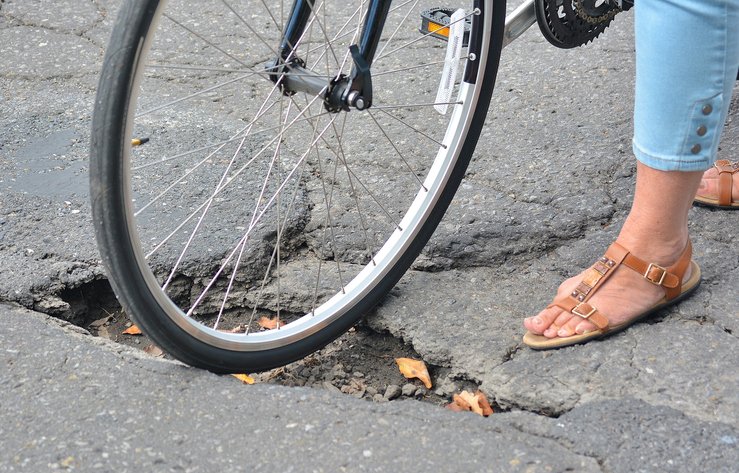
- Do not move the bike before you photograph the hole. The relationship between the wheel and the defect is the most persuasive single image in the file. Take that picture before anyone helps you up.
- Drop a coin or a pen into the pothole and re-photograph. A quarter is roughly an inch across. A standard pen is six inches long. A jury or an adjuster looking at a photo months later has no scale otherwise.
- Photograph the surrounding area at four compass points. Street signs, the nearest intersection, the lane markings. This anchors the location for the agency that owns the road.
- Call non-emergency dispatch even if no car was involved. Ask for an officer or deputy to come document the scene and issue an incident number. Without the number, the county will later argue the hole did not exist.
- Open a 311 complaint from the scene if you can. The City of Fort Myers Request for Action line is 239-533-9400. Logging your own complaint creates a public record with a timestamp before the agency has had the chance to fill the hole.
- Save the bike. Do not let the shop trash it. The frame, the wheel, and the helmet are evidence. Tag them and put them in a garage. We have had bent forks examined by a metallurgical engineering witness more than once.
- Open PIP within fourteen days. Florida PIP is forfeited if you do not receive initial treatment inside fourteen days of the crash under §627.736. That deadline is hard, and it does not care that you thought a sore wrist would resolve on its own.
- Pull a Google Street View history of the location. If the hole appears in an image from six months ago, the county’s reasonable-time defense gets a lot harder. Do this before they patch the road, which sometimes happens within days of a documented incident.
- Do not give a recorded statement to anyone. Not the county’s risk management office, not the driver’s carrier, not your own carrier. Talk to an attorney first.
Key Takeaways
- Florida’s modified comparative negligence rule under §768.81 means a cyclist found 51 percent or more at fault recovers nothing — the defense will spend the case trying to push you over that line.
- The statute of limitations on a Florida negligence claim is now two years under §95.11(4)(a), not four, for any crash on or after March 24, 2023.
- If you own a Florida-registered car, your own PIP under §627.736 generally pays the first $10,000 of medical bills after a bicycle crash, even when no vehicle was involved.
- Suing a city or county over a pothole means dealing with sovereign immunity — a $200,000 per-person damages cap, a written notice of claim, and a 180-day waiting period before suit.
- The strongest pothole files we open have prior 311 complaints, prior maintenance tickets, or visible vegetation inside the hole that proves the defect existed long before your crash.
Frequently Asked Questions
Q1. Can I sue the City of Fort Myers or Lee County for a pothole that caused my bicycle crash?
Sometimes, but the bar is higher than in a typical negligence case. Florida sovereign immunity caps damages at $200,000 per person and $300,000 per incident under §768.28, and you have to serve a written notice of claim and wait 180 days before filing suit. You also have to prove the public agency had actual or constructive notice of the pothole and a reasonable chance to fix it. Photos that show vegetation in the hole, prior 311 complaints, or a maintenance log entry are usually what carries that proof.
Q2. How long do I have to file a pothole bicycle injury claim in Florida?
Under §95.11(4)(a), the statute of limitations for negligence is two years from the date of the crash. That was four years before the 2023 tort reform, and we still meet cyclists who think they have the older window. If the defendant is a city or county, you have to serve a presuit notice within three years, but the underlying two-year filing deadline still controls. Move quickly.
Q3. Will my own car insurance pay my medical bills after a bike crash with no driver involved?
Often yes. Florida PIP under §627.736 follows the named insured even when they are on a bicycle, so if you own a Florida-registered vehicle the $10,000 in no-fault medical generally applies. Uninsured Motorist under §627.727 can also stack here if a phantom car forced you into the hole. We see this combination more than people expect, and most cyclists do not realize their own auto policy is the first line of medical coverage.
Q4. What if I was partly at fault for not seeing the pothole?
Florida changed the rule in 2023. Under §768.81 as amended, if a jury finds you 51 percent or more at fault, you recover nothing. At 50 percent or below, your recovery is reduced by your percentage of fault. Riding at dusk without a headlight, looking down at a phone, or crossing into a travel lane are the kinds of facts a defense team will push to get a cyclist above the 50 percent line.
Q5. Do I need a police report if no car was involved in my pothole crash?
It helps. Florida §316.066 requires a crash report when a motor vehicle is involved, but a solo bicycle pothole wreck does not automatically trigger that statute. Call non-emergency dispatch anyway and ask for a deputy or officer to document the scene. A timestamped public record of the pothole, your injuries, and the road condition is hard to manufacture later, and it tends to anchor the case if the county claims the hole did not exist.
Call our office
If you have been hurt on a bike on a Fort Myers road and you are trying to figure out who is responsible for the pothole that put you down, call our office at 239-992-8259 for a free consultation. We handle bicycle crashes across Lee and Collier Counties, and there is no fee unless we recover for you.
About the Author

David B. Pittman, Esq. has practiced personal injury law in Fort Myers and across Lee County for more than thirty years, and is the founder of Pittman Law Firm, P.L. The firm’s Fort Myers presence handles a steady stream of serious-injury work along the Daniels Parkway, Six Mile Cypress, McGregor Boulevard, Cleveland Avenue, and Summerlin Road corridors, and along I-75 between Estero and Bell Tower, representing injured clients across Lee and Collier Counties, with a particular focus on commercial-vehicle, complex-liability, and serious-injury cases.
Before founding Pittman Law Firm, P.L., David completed his undergraduate work at The Citadel, The Military College of South Carolina and his JD at the University of South Carolina School of Law. He is AV-Preeminent at Martindale-Hubbell and a member of the Multi-Million Dollar Advocates Forum.
David has held a Florida real estate broker license for twenty-five years, a credential that shapes how the firm reads the property side of premises cases. The firm handles personal injury cases across Lee and Collier Counties, serving Fort Myers, Bonita Springs, Naples, Cape Coral, Estero, and Lehigh Acres, with offices at Windsor Place in Bonita Springs (main) and Fort Myers (satellite). Call 239-992-8259 for a free consultation.
Disclaimer: The information on this page is general legal information about Florida personal injury law and is not legal advice for any particular case. Reading this page does not create an attorney-client relationship with Pittman Law Firm, P.L. Outcomes described are based on the facts of those individual cases and are not a guarantee of any future result. Attorney advertising.