

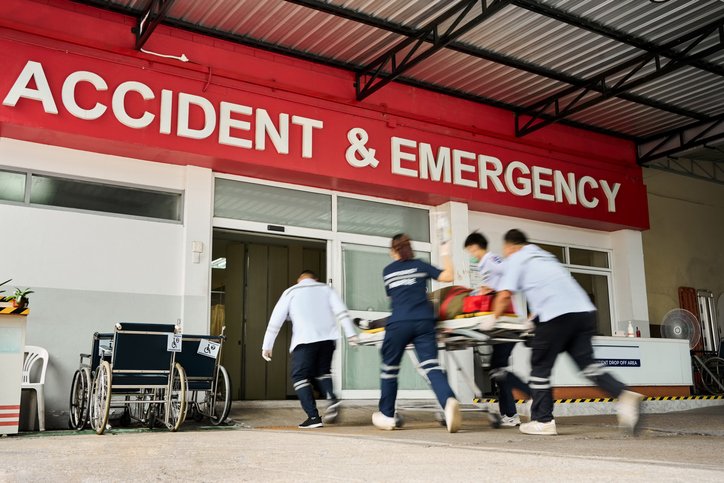
Car Accident in Fort Myers? Why Your Choice Between ER vs Urgent Care Matters
Under §627.736, your PIP benefit pays up to $10,000 — but only if a qualified provider documents an Emergency Medical Condition. If no EMC is on the chart, the cap drops to $2,500. Hospital emergency departments write EMC determinations as a matter of routine. Many urgent care clinics in Lee County do not. That paperwork difference is $7,500, and it shows up on the carrier’s adjuster notes before it shows up on your explanation of benefits.
The call I get two weeks after a crash usually sounds like this: “I went to the urgent care on Cleveland Avenue because the ER wait was four hours, and now the adjuster is telling me my PIP is limited to $2,500.” I want to give you the information before that call, not after. Below is the plain-English breakdown of the PIP statute, the five patterns we see in our office, and a real case that turned on the difference between a same-day ER visit and a delayed urgent-care visit.
What Florida law actually says about post-crash medical care
Three statutes do most of the work here, and each one has a plain-English version worth knowing.
§627.736, Florida Statutes — the PIP statute. Florida is a no-fault state for medical bills, which means your own auto policy pays the first chunk of your post-crash medical care regardless of who caused the wreck. The cap is up to $10,000 — but only if a qualified provider documents what the statute calls an Emergency Medical Condition (EMC). If no EMC is documented, the cap drops to $2,500. The statute also imposes a hard fourteen-day rule: you have to be seen by an approved provider within fourteen days of the crash, or you lose PIP entirely. There is no extension and there is no good-cause exception. Read the statute on flsenate.gov.
§768.81, Florida Statutes — modified comparative negligence. In 2023 Florida switched from pure comparative negligence to a modified 51% bar. In plain English: if a jury finds you 50% or less at fault for the wreck, your recovery is reduced by your share of fault. If a jury finds you 51% or more at fault, you recover nothing. That matters in the ER-versus-urgent-care choice because gaps and inconsistencies in your medical record give defense attorneys raw material to push your fault percentage up at trial. Section 768.81 on flsenate.gov.
§95.11(4)(a), Florida Statutes — the two-year statute of limitations. Also from the 2023 reform: the deadline to file a negligence lawsuit for a car wreck is now two years from the date of the crash, not four. The medical record you build in those first two weeks is the spine of the case you may have to file in those two years. Section 95.11 on flsenate.gov.
Add in §316.066 (the crash-report statute, which makes a Florida Traffic Crash Report a near-mandatory document on any injury wreck) and you have the four pieces of paper a Fort Myers case usually lives or dies on: the crash report, the ER record, the EMC determination, and the radiology read.
Five Fort Myers post-crash patterns — and what went wrong each time
After enough years on this work, the calls start to sort themselves into a handful of patterns. Five of them come up over and over on Fort Myers crashes:
- The “I felt fine and went home” call. Client walks away from a fender-bender on McGregor Boulevard, declines transport, wakes up two mornings later with a stiff neck and a dull headache. By day five the pain is real, and on day twelve they finally see a doctor. That is cutting the fourteen-day rule far closer than I’d ever advise.
- The “I went to urgent care because the ER wait was four hours” call. Common on Cleveland Avenue and Colonial Boulevard wrecks during snowbird season. Treatment was fine. The problem is that no EMC determination was made, so the PIP cap stays at $2,500 instead of $10,000.
- The “kids were fine, I’ll get checked tomorrow” call. Parent prioritizes the children first, which is the right human instinct, and then loses track of their own concussion symptoms for three or four days. The medical record arrives late and the gap shows up later in the carrier’s denial letter.
- The “I have a high-deductible plan and I’m scared of the bill” call. A real concern, and one we handle every week. PIP pays the first $10,000 of medical regardless of fault, and our office routes the ER bill into the PIP carrier before health insurance touches it. The fear of the bill is usually solvable. Skipping the ER to dodge the bill almost never is.
- The hit-and-run call. Driver flees the scene. Client thinks because the at-fault party is gone there is no case. There is. Florida’s uninsured motorist coverage under §627.727 is built exactly for this. UM statute. But the medical record from the first 24 to 48 hours is still the foundation.
Three reasons the ER-versus-urgent-care choice matters for your claim
On paper the rule sounds simple. Severe symptoms go to the ER. Minor symptoms go to urgent care. In practice the line is rarely that clean. Three real-world complications show up in our cases.
The adrenaline window lies to you. Most people walk away from a wreck feeling more wound up than hurt. The endorphins that flood your system in the minutes after a crash mute pain signals for hours. Whiplash typically peaks twelve to thirty-six hours later. A concussion can develop dizziness and concentration problems over the course of a week. The version of you who says “I’m fine” in the parking lot is not yet the version of you who actually knows whether you’re fine.
Urgent care is not built to call an EMC. Many urgent care providers in Lee County are physician assistants and nurse practitioners working under standing orders. Their job, very competently, is to handle sprains, stitches, and low-grade fevers. Documenting an Emergency Medical Condition under §627.736 is a different workflow. Some do it. Many won’t. You won’t know until the PIP carrier’s adjuster reads the chart, which is often the week your bills start arriving.
The defense reads every gap. Insurance defense attorneys are trained to argue that any delay between the wreck and the first medical visit equals an injury that wasn’t caused by the wreck. A four-day gap becomes a story about a gym injury or a yard-work strain that the client supposedly hid. The cleaner the early medical timeline, the less of that story the defense can build.
On the practical side, the ER trauma teams at Lee Memorial on Cleveland Avenue, HealthPark off Summerlin Road, and Gulf Coast Medical Center near Daniels Parkway are set up for crash work. They CT and image as a matter of routine, they generate EMC determinations, and the records are clean enough that a jury two years later can follow them.
A US-41 hit-and-run where the ER visit on day one closed the case
A client was stopped in traffic on US-41 in Fort Myers when she was rear-ended hard by a driver who didn’t stop. He sped off through the intersection and was never identified. She had the presence of mind to take a phone picture of the back of the fleeing car, which gave the responding officer something to work with, but no plate ever matched.
She felt rattled at the scene, declined the ambulance, and drove herself home. By the next morning her neck wouldn’t turn. She went to the ER that afternoon, which was the right call for two reasons. The first was medical — the imaging picked up the cervical strain that turned into months of physical therapy and pain management. The second was documentation — the EMC determination written that day moved her PIP cap to $10,000 and locked the injury to the wreck, in writing, within twenty-four hours of impact.
The case settled for the full policy payout, which was the best available outcome given that the fleeing driver was never identified. None of that recovery would have looked the same if the first medical visit had been at day ten instead of day one.
The lesson I take from cases like this one — and I see versions of it every month — is that the ER visit on day one is almost always cheaper, in the end, than the urgent care visit on day four.
What to do if you’ve just been in a crash in Fort Myers
Practical, observed-from-experience checklist. This is the version I give my own family members.
- Call 911 from the scene if anyone has chest pain, head trauma, breathing trouble, severe bleeding, or numbness or tingling. The Lee County dispatchers route to the nearest trauma-capable hospital, which is usually Lee Memorial on Cleveland Avenue, Gulf Coast on Daniels Parkway, or HealthPark off Summerlin Road. Let them route. Don’t drive yourself if you have any of those symptoms.
- If you didn’t go by ambulance, go to the ER that same day if you can — within 48 hours at the outside. Tell intake the visit is for evaluation following a motor vehicle crash. Ask, in writing if possible, whether an EMC determination was made.
- Photograph the scene before you leave. Both cars, the intersection, skid marks if you can see them, road signs, your odometer, the other driver’s plate, and any storefront with a camera angle that could have caught the wreck. Cell-phone photos have saved more cases in my office than dashcam footage.
- Get the crash report number from the responding officer. §316.066 makes a Florida Traffic Crash Report standard on any injury wreck. The case file starts there.
- Write the wreck down within 24 hours. Date, time, weather, where you were going, what you saw, what you felt. Memory blurs faster than people realize. A page of notes written the night of the crash is worth more than an hour of recall a year later.
- Don’t give the other driver’s insurer a recorded statement before talking to a lawyer. The first call is usually friendly. The second call is usually about reducing your claim. There is no Florida statute requiring you to give a recorded statement to the at-fault carrier.
- Keep every receipt and every appointment. Mileage to physical therapy on Six Mile Cypress Parkway counts. Prescription co-pays count. Time off work counts. PIP and any bodily-injury settlement reimburse what you can document.
Key Takeaways
- An ER visit after a Fort Myers crash typically generates an Emergency Medical Condition determination under §627.736, which preserves the full $10,000 PIP benefit instead of dropping the cap to $2,500.
- Florida’s fourteen-day rule is hard. Day fifteen is too late, regardless of the reason.
- Adrenaline hides injuries for hours and sometimes days; a clean early medical record protects both your health and your case.
- Florida’s 2023 reforms shortened the negligence statute of limitations to two years (§95.11(4)(a)) and added a 51% bar for fault (§768.81). Documentation gaps cost more than they used to.
- Hit-and-run cases are still recoverable through uninsured motorist coverage under §627.727 when the ER record and the crash report line up.
Frequently Asked Questions
Q1. Does going to urgent care instead of the ER cut my Florida PIP coverage from $10,000 down to $2,500?
It can. Florida PIP under §627.736 pays up to $10,000 only if a qualified provider declares an Emergency Medical Condition (EMC). If no EMC is documented, your PIP benefit is capped at $2,500. Hospital ER teams write EMC findings as a routine part of the visit. Many urgent care providers do not. That single piece of paperwork is the difference between $10,000 and $2,500 in available no-fault medical.
Q2. How long do I have to be seen by a doctor after a Fort Myers crash before I lose PIP?
Fourteen days from the date of the crash. Florida §627.736 requires initial medical care within fourteen days, or PIP benefits are forfeited entirely. The clock is hard. Day fifteen is too late, no matter how good the reason.
Q3. If I feel fine at the scene, do I still need to be checked out?
Yes. Adrenaline masks soft-tissue and head injuries for hours and sometimes days. Whiplash often shows up the next morning. Concussion symptoms can drift in over a week. Get a baseline exam within a day or two of the crash, even if you walked away. It protects your health and it preserves the medical record that ties any later symptoms back to the wreck.
Q4. Can I be sent to collections by the ER while my Florida PIP and the at-fault driver’s insurer fight about the bill?
Hospitals can bill you while liability is sorted, which is why our office sends a letter of representation to providers and works with our client’s PIP carrier to push the $10,000 toward emergency bills first. We also evaluate whether a letter of protection can hold a bill until the bodily-injury settlement comes in. It is not automatic, but it is part of what we handle.
Q5. Does going to the ER instead of urgent care help or hurt my injury case?
It usually helps. An ER visit produces a contemporaneous record, an EMC determination, imaging when warranted, and a clean injury timeline. Insurers have a harder time arguing the injuries are unrelated to the crash. Urgent care can still work for genuinely minor injuries, but on anything ambiguous, the ER record is the stronger document for the claim.
Talk to our office about your Fort Myers crash
If you or someone in your family has been hurt in a wreck in Fort Myers, Cape Coral, Estero, Bonita Springs, or Naples, our office is glad to walk through the medical and PIP timeline with you. Consultations are free, and there is no fee unless we recover for you. Call 239-992-8259 or reach us through our contact page. The sooner we hear from you, the more we can do — particularly inside that first fourteen-day window.
About the Author

David B. Pittman, Esq. founded Pittman Law Firm, P.L. and has spent more than thirty years handling personal injury cases in Fort Myers and across Lee County, with a sustained focus on serious-injury auto and complex-liability cases. The firm’s Fort Myers presence handles a steady stream of serious-injury work along the Daniels Parkway, Six Mile Cypress, McGregor Boulevard, Cleveland Avenue, and Summerlin Road corridors, and along I-75 between Estero and Bell Tower.
David holds an AV-Preeminent rating from Martindale-Hubbell and belongs to the Multi-Million Dollar Advocates Forum. His undergraduate degree is from The Citadel, The Military College of South Carolina, and his JD is from the University of South Carolina School of Law.
David has held a Florida real estate broker license for twenty-five years, a credential that shapes how the firm reads the property side of premises cases. The firm handles personal injury cases across Lee and Collier Counties, serving Fort Myers, Bonita Springs, Naples, Cape Coral, Estero, and Lehigh Acres, with offices at Windsor Place in Bonita Springs (main) and Fort Myers (satellite). Call 239-992-8259 for a free consultation.
The information on this page is for general educational purposes and is not legal advice. Reading this article does not create an attorney-client relationship with Pittman Law Firm, P.L. Every case turns on its own facts, and outcomes vary. This is attorney advertising. Prior results do not guarantee a similar outcome.