

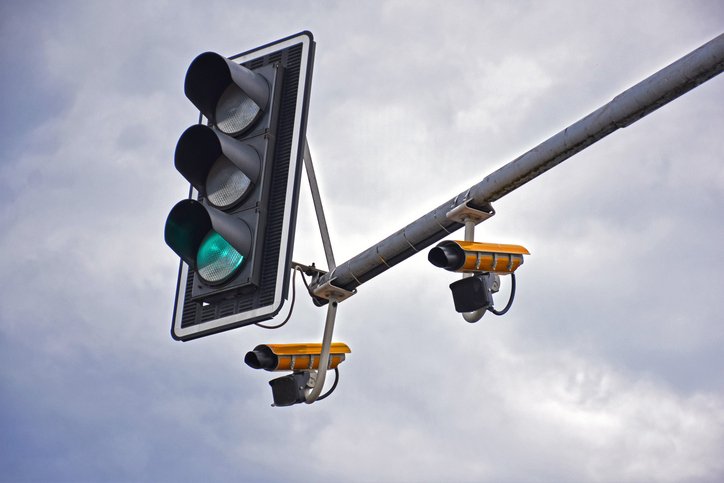
Can Traffic Camera Footage Help Your Fort Myers Car Injury Claim?
Most intersection cameras in Fort Myers and Lee County overwrite their footage on a rolling loop — anywhere from 72 hours to 30 days depending on the agency. Private business cameras at the gas station or fast-food lot on the corner often erase in a week. A car crash happened at the corner of Cleveland Avenue and Colonial Boulevard this morning. By Monday, the recording may be gone regardless of what the law eventually says about the claim.
That time pressure is what shapes everything about camera footage in a Florida personal injury case. Here is how it actually works, where the footage lives, and what our office does in the first 24 hours to preserve it.
What Florida law actually says about traffic camera evidence
Florida does not have a single statute called “the traffic camera law.” What we have, instead, is a set of rules that govern (a) how the citation side of red light cameras works, (b) what crash reports have to capture, and (c) how the civil injury claim itself plays out. The video footage cuts across all three.
On the citation side, Florida red light cameras are governed by §316.075 and the Mark Wandall Traffic Safety Program at §316.0083, FL Stat. The ticket goes to the registered owner of the vehicle. The owner can pay it, contest it, or in writing transfer responsibility to whoever was actually driving. Plain English: getting a red light camera ticket does not, by itself, mean you are legally on the hook for a civil injury claim — and a civil injury claim does not require somebody to have first gotten a camera ticket. The two tracks are separate, but the underlying video belongs to both.
On the report side, §316.066, FL Stat. requires a written crash report any time the wreck involves an injury, a death, or property damage requiring a tow. The officer’s narrative is what goes onto that long-form crash report, and it is the first piece of paper an adjuster will ask for. A well-documented report that references “intersection video reviewed at the scene” is worth a great deal in the early claim posture.
On the civil side, three statutes do most of the work:
- §768.81, FL Stat. — Modified comparative negligence. After the 2023 tort reform, if a jury finds you 51% or more at fault, you recover nothing. Plain English: if the insurer can push your share of fault past the halfway line, your claim dies. Clean camera footage is the single best tool we have for keeping that fault percentage where it belongs.
- §95.11(4)(a), FL Stat. — Two-year statute of limitations. The 2023 reform cut the negligence filing window from four years to two. Plain English: in most Florida car crash cases that happened on or after March 24, 2023, you have two years from the date of the crash to file suit. Camera footage that disappears in week two of that two-year window is a problem you cannot fix later.
- §627.736, FL Stat. — PIP. Florida is a no-fault state for the first $10,000 of medical bills. Plain English: regardless of who caused the wreck, your own auto policy’s Personal Injury Protection pays the first $10,000 of medical (up to 80%) and lost wages (up to 60%), as long as you see a doctor within 14 days. The camera footage matters for the bodily injury claim beyond PIP, not for PIP itself.
Seven camera sources our firm targets in Fort Myers crash investigations
People hear “traffic camera” and picture one thing: a city-owned box hanging off the mast arm of a signal at a major intersection. In practice, the camera that ends up saving a case is rarely the one the client expected. Here are the seven sources our firm pulls from most often on Fort Myers wrecks:
- City and Lee County intersection cameras. Signal-arm cameras at high-volume intersections — for example, along Cleveland Avenue, at Colonial Boulevard, and at the cluster of intersections feeding Daniels Parkway near the airport. Retention windows are short. Sometimes 72 hours, sometimes longer, depending on the agency and the storage system.
- FDOT roadway cameras. Florida Department of Transportation maintains live traffic cameras along I-75 and major state roads. These are usually live-view only and do not record continuously, but the agency does sometimes pull and retain clips around reported incidents.
- Red light camera systems. Where these are deployed under §316.0083, FL Stat., they capture the violation event plus a short buffer. The vendor (not the city) is often the actual holder of the footage, which changes the preservation letter address.
- Private business surveillance. Gas stations, drive-thrus, fast-food parking lots, auto dealerships along Cleveland Avenue and Pine Island Road, and the storefronts along McGregor Boulevard often have exterior cameras with a view of the street. Retention is short and usually overwrites on a 7-to-14 day loop.
- Apartment-complex and gated-community cameras. Common around Daniels Parkway and the corridor between Six Mile Cypress Parkway and Treeline. Property managers will hand over footage if asked early and with a written request.
- Residential doorbell and yard cameras. The fastest-growing category, and often the cleanest video. Neighbors will hand over a clip if you knock on the door within a day or two of the wreck.
- Other drivers’ dashcams. Almost every commercial truck running I-75 near Alico Road has a forward-facing dashcam. So do a growing share of rideshare drivers and a meaningful slice of private vehicles. Get the names and phone numbers at the scene.
Five reasons good footage does not always translate to a quick settlement
Reading what I just wrote, you might think the video either exists or it does not, and if it exists you win. It is not that simple. A few of the practical complications we run into on Fort Myers cases:
Retention windows are short and they are unforgiving. The single most common mistake I see is people waiting four or six weeks to call a lawyer because they thought the insurance company was going to handle it. By the time we are retained, the gas station footage is gone, the apartment-complex DVR has overwritten itself, and the intersection feed has rolled past the cutoff. There is nothing to subpoena because there is nothing left.
Camera angles lie about speed and distance. A wide-angle lens on a storefront camera compresses distance. A high-mounted intersection camera flattens lanes. Without a reconstruction engineer who knows how to interpret what the lens is actually showing, well-meaning footage can be read backward. We have had cases where the raw video looked bad for our client until somebody who actually understood camera geometry walked the jury through what they were seeing.
The vendor is not the city. On red light camera systems, the public agency contracts with a private vendor that holds the footage. A subpoena addressed to the wrong party comes back empty. The preservation letter has to go to the right entity, in the right form, within the right window.
Authentication is a real requirement. Video does not walk itself into evidence. Under the Florida Evidence Code, the party introducing the recording has to show it is what it purports to be. That means a custodian, a chain of custody, and sometimes a metadata declaration. Defense lawyers will absolutely fight authentication if they think they can keep the video out.
Cameras capture the crash but not the cause. A clean angle of a T-bone at Colonial Boulevard and Fowler tells you the geometry of the collision. It does not tell you that the at-fault driver was on the phone, was speeding for the last quarter mile, or had two prior at-fault wrecks in the last eighteen months. Camera footage is one layer of the case; it is not the whole case.
What to do if you think a camera caught your Fort Myers crash
This is the action list I give clients when they call from the scene, or from the hospital, or from their kitchen table the next morning. It is short on purpose. The legacy version of this article had a long generic checklist, and most of it was the kind of advice that sounds useful and is not. Here is what actually moves the needle:
- Stay at the scene and call 911. A written crash report under §316.066, FL Stat. is the foundation of everything that follows. If you can, ask the responding officer whether they noted any intersection or business cameras visible from the crash point. Many will write it into the narrative if you ask.
- While you are still at the scene, look up. Signal mast arms, light poles, business storefronts, ATM kiosks, doorbells on nearby houses. Take a wide photo of the intersection or stretch of road that captures every camera location you can see. Five minutes of photography at the scene has saved more cases at our firm than I can count.
- Get the names and numbers of the drivers behind you and beside you. Dashcam ownership has gone way up. The driver who stopped behind you on I-75 near Alico Road may have the cleanest forward-facing video of the wreck that exists anywhere.
- Write down the businesses you can see from the crash point. The gas station on the corner. The drive-thru. The dealership across the street. Each one is a potential camera. The preservation letter goes to the property owner and to the corporate office.
- Get to a doctor within 14 days. Not because of the camera footage — because of PIP under §627.736, FL Stat. If you do not seek care within fourteen days of the crash, you lose your no-fault medical benefits entirely. I have seen people lose ten thousand dollars of available coverage because they wanted to “wait and see if the soreness goes away.”
- Call an attorney quickly enough that the preservation letters can actually go out. The retention window on a gas station DVR is not a legal deadline. It is a technical reality. The clock starts the moment the wreck happens, and nobody who matters in the city or county is going to call the property owner for you. The preservation letter is on us, but only if we are retained in time to send it.
Key Takeaways
- Traffic camera and private surveillance footage can be powerful evidence in Fort Myers car injury claims, but retention windows are short — often 72 hours to 30 days for public cameras and 7 to 14 days for most private systems.
- Florida’s comparative-negligence rule under §768.81, FL Stat. means clean footage can keep your share of fault below the 50%-plus line that would bar recovery entirely after the 2023 reform.
- The two-year statute of limitations under §95.11(4)(a), FL Stat. does not save the video. Footage disappears in days, not years, regardless of how long you have to file suit.
- The seven most useful camera sources we see in Fort Myers cases are intersection cameras, FDOT roadway feeds, red light camera vendors, private business surveillance, apartment-complex DVRs, residential doorbells, and other drivers’ dashcams.
- The single biggest mistake is waiting weeks to call a lawyer. By then the footage is gone, the witnesses have moved on, and the case is harder than it had to be.
Frequently Asked Questions
Q1. How long does Fort Myers traffic camera footage stay before it is erased?
Most City of Fort Myers and Lee County intersection feeds overwrite themselves on rolling windows that run anywhere from 72 hours to about 30 days, depending on the camera and the agency. Private camera footage from a gas station, store, or apartment complex is often gone in 7 to 14 days. If a serious crash happened on Cleveland Avenue, Colonial Boulevard, or near Daniels Parkway, the preservation letter needs to go out within days, not weeks.
Q2. Is traffic camera footage admissible in a Florida personal injury case?
Yes, when it is properly authenticated. The party introducing the video has to show the camera was working, the recording is accurate, and the chain of custody is clean. We have used intersection footage and private surveillance video as direct proof of who ran the light, who was in the turn lane, and how fast a vehicle was going at impact.
Q3. Do red light cameras in Fort Myers create tickets I have to pay?
Florida red light camera tickets are issued under §316.0083, FL Stat., and the ticket goes to the registered owner of the vehicle. The owner can challenge the citation, transfer responsibility to the actual driver in writing, or contest it before a hearing officer. A red light camera ticket is separate from a civil injury claim, but the underlying footage can absolutely be requested for the injury case.
Q4. What should I do at the scene to make sure camera footage gets preserved?
Call 911 and let the report get written under §316.066, FL Stat. Look around for cameras on traffic signal mast arms, on nearby business storefronts, on doorbell systems at houses, and on dashcams in other stopped vehicles. Take photos of camera locations, ask witnesses for their phone numbers, and write down the businesses you can see from the crash point. Then call an attorney quickly so a preservation letter can go out.
Q5. What if the other driver was clearly at fault on camera but the insurer still denies the claim?
Insurers deny good claims more often than people realize, even when the video is clear. Under §768.81, FL Stat., Florida is a modified comparative negligence state, and adjusters will sometimes try to push 51% of the fault onto you to bar recovery. Clean footage, a reconstruction analysis, and a properly documented claim file are what move those denials. That is the part of the job where having the video early matters most.
Talk to a Fort Myers Car Accident Attorney
If you were hurt in a Fort Myers wreck and you think there may be camera footage out there, the worst thing you can do is wait. Call our office at 239-992-8259 for a free consultation. We will start the preservation work that day. There is no fee unless we recover for you.
About the Author

Pittman Law Firm, P.L. — a personal injury practice that has operated in Fort Myers and across Lee County for more than thirty years — is led by founder David B. Pittman, Esq. The firm’s Fort Myers presence handles a steady stream of serious-injury work along the Daniels Parkway, Six Mile Cypress, McGregor Boulevard, Cleveland Avenue, and Summerlin Road corridors, and along I-75 between Estero and Bell Tower. David represents injured clients across Lee and Collier Counties, with a particular focus on commercial-vehicle, complex-liability, and serious-injury cases.
Academically, David is a graduate of The Citadel, The Military College of South Carolina, and earned his JD from the University of South Carolina School of Law. Professionally, he holds an AV-Preeminent rating with Martindale-Hubbell and is a member of the Multi-Million Dollar Advocates Forum, reflecting more than thirty years of personal injury practice in Southwest Florida.
David has held a Florida real estate broker license for twenty-five years, a credential that shapes how the firm reads the property side of premises cases. The firm handles personal injury cases across Lee and Collier Counties, serving Fort Myers, Bonita Springs, Naples, Cape Coral, Estero, and Lehigh Acres, with offices at Windsor Place in Bonita Springs (main) and Fort Myers (satellite). Call 239-992-8259 for a free consultation.
Disclaimer: This article is for general information only and is not legal advice. Reading it does not create an attorney-client relationship with Pittman Law Firm, P.L. Every case is different and outcomes depend on the specific facts. Past results do not guarantee future outcomes. This is attorney advertising.