

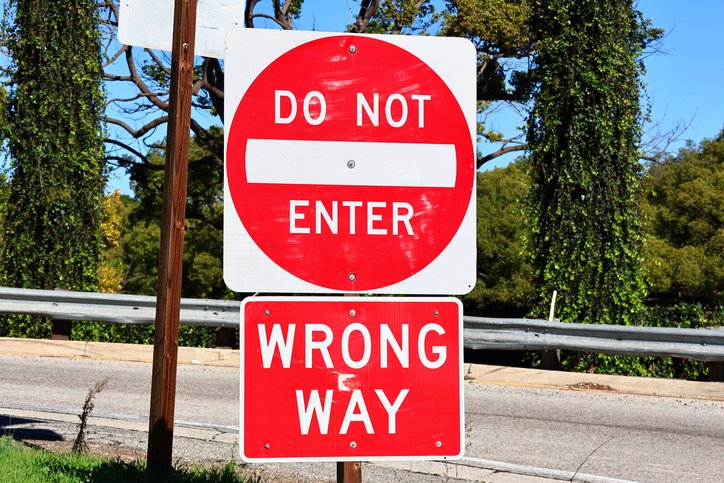
Why Wrong Way Sign Failures Lead to Fatal Fort Myers Car Accidents
Most families I talk to after a wrong-way crash assume the case is about the driver who was drunk. Sometimes it is. But on a number of files I have handled in Fort Myers and along the I-75 corridor through Lee County, a faded or missing wrong-way sign at the ramp was what put the vehicle on the wrong road in the first place. The drunk driver is a real defendant. The agency that knew that sign was failing and did not replace it may be one too.
That distinction matters because it changes the recovery. A wrong-way driver with a minimum Florida policy and no assets may leave the injured family with a $10,000 PIP check and nothing else. A case that also names the road-maintenance contractor, or the bar that overserved the driver, or an employer whose employee was on the clock — that case can reach the full value of the harm. This is the piece of wrong-way crash law that most people never hear about until they are sitting in our office.
What Florida law actually says about wrong-way crashes
Three statutes do most of the heavy lifting in these cases. None of them are complicated once you strip the legalese off.
Modified comparative negligence — §768.81, Florida Statutes. Florida reformed this rule in 2023. The plain-English version: if a jury finds you 50% or more at fault for your own injuries, you recover nothing. If you are 49% or less at fault, your recovery is reduced by your percentage. In a wrong-way crash where you were driving in your own lane and a vehicle came at you head-on, your fault percentage is almost always zero. The fight is whether the wrong-way driver carries 100% of the blame or whether the road designer, the sign maintainer, or a bar that overserved the driver picks up a share.
Statute of limitations — §95.11(4)(a), Florida Statutes. The same 2023 reform cut the negligence filing deadline from four years down to two. Two years from the date of the crash, full stop. Wrongful-death cases also run two years. Families lose viable claims every month in Florida because they thought they still had the old four-year window. They do not.
PIP and UM coverage — §627.736 and §627.727. Wrong-way drivers in Florida are often uninsured or under-insured, especially when alcohol is involved. PIP gives you the first $10,000 of medical bills no matter who was at fault. Uninsured Motorist coverage on your own policy is what actually pays serious injury damages when the at-fault driver has nothing to take. I tell every client and every friend who asks: stack your UM. The premium difference is small and it is the single most important coverage you carry in Florida.
One more statute I bring up because the police report sometimes contains the only contemporaneous account of where the wrong-way vehicle entered: §316.066 requires a written crash report for any wreck involving injury, death, or substantial property damage. Get a copy. Read it. The narrative section often tells you whether the responding trooper noted a sign issue at the entry ramp.
Five wrong-way fact patterns from our Fort Myers files — and why they differ legally
Categorizing these cases by “the driver was drunk” misses how they really happen. I see the same five fact patterns come through:
- The impaired-driver, late-night I-75 case. The driver enters southbound I-75 from a northbound off-ramp, usually between midnight and 4 a.m., and travels several miles before impact. Alcohol is the headline cause. But on multiple files I have worked, the on-ramp where the driver entered had a faded or partially obstructed wrong-way sign that arguably contributed.
- The confused-tourist interchange case. The driver is unfamiliar with the diverging-diamond interchange or the partial cloverleaf, takes the wrong arm of a Y, and ends up going the wrong way on a divided road like Six Mile Cypress Parkway or Colonial Boulevard. Sober driver, brand-new rental car, unfamiliar geometry. These are the ones where road design itself is the defendant.
- The medical-event case. An older driver, sometimes with the onset of dementia, sometimes mid-stroke, ends up on the wrong side of the road. The driver is not legally at fault in the moral sense, but the recovery comes from the driver’s policy and from any UM coverage the injured family carries.
- The lost-after-dark case. A driver gets disoriented in a poorly lit area, often near Pine Island Road in north Cape Coral or a rural stretch of Cleveland Avenue, sees what looks like a road, and pulls onto a one-way segment going the wrong direction. Faded markings and missing signage are the through-line.
- The sign-failure rear-end aftermath case. A wrong-way driver hits a vehicle, and a chain reaction follows. The original tort is the wrong-way driver’s, but the secondary injured drivers often have viable claims against multiple parties because their injuries occurred in the chain crash, not the initial impact.
Three complications that turn a clear-liability wrong-way crash into a prolonged fight
From the outside, a wrong-way crash looks like the easiest liability case in personal injury. One driver was going the right way; one was going the wrong way. Done. In reality, our office sees three recurring complications that turn a “clear” case into a long fight.
The wrong-way driver often has no meaningful insurance. Especially when alcohol is involved, the at-fault driver may be carrying Florida’s bare-minimum policy or no policy at all. Without UM coverage on the injured family’s side, the realistic recovery against the driver may be a small fraction of the medical bills. This is why so much of the work in these cases shifts to finding additional defendants — the bar, the sign maintainer, an employer if the driver was on the clock.
Government defendants raise sovereign-immunity hurdles. If a faded wrong-way sign at an FDOT-maintained ramp contributed, Florida’s sovereign-immunity waiver under §768.28 caps damages and imposes a strict pre-suit notice procedure. The notice must go to the right agency within a specific window, and missing it kills the claim. Damages against the state are capped at $200,000 per person and $300,000 per incident absent a claims bill. The cap does not mean the case is not worth bringing, but it changes the strategy.
Evidence disappears fast. The faded sign that helped cause the crash will be replaced within weeks once the agency is on notice of the crash. Maintenance logs get purged on retention schedules. Surveillance footage from nearby businesses overwrites in 30 to 90 days. If we are not on the file inside the first two weeks, the road-defect theory often becomes unprovable. I have watched it happen.
A case worth knowing about — when the institution knew and did nothing
A family came to us after they found unexplained bruising on their mother’s upper arms during a Sunday visit to her assisted-living facility off McGregor Boulevard in Fort Myers. The marks were finger-shaped. She had also become withdrawn over the prior two weeks, fearful of certain shifts, not eating well. The family had asked the facility for an explanation twice and gotten a runaround the first time and a deflection the second.
Within the week we had a preservation letter on the facility, we had a private investigator pulling shift records, and we had an outside geriatric nurse retained to review the resident’s chart. The pattern that emerged matched what the family suspected. The staff member responsible was identified and terminated by the facility, and we worked with the family to move the resident to a different facility where she could heal.
The civil case resolved with a confidential settlement that funded the resident’s future care and ongoing mental-health support, which was the family’s priority from day one. They did not want a public fight. They wanted their mother safe and the staff member out of the facility. We got both.
I include this in a wrong-way piece because the throughline is the same as the road-defect piece of a wrong-way crash: when an institution, a nursing home, a road agency, a contractor, has notice of a danger and does not act in time, the harm that follows is not the original wrongdoer’s alone. The family deserves a recovery from everyone who could have prevented the injury and did not.
What to do if you survive a wrong-way crash in Fort Myers
This is the section where most blogs hand you a generic checklist. I am going to give you the specific moves I have used with clients over thirty years that consistently change case outcomes.
- Photograph the wrong-way driver’s entry point before you leave the scene if it is safe to do so. If the driver entered at a ramp half a mile back, that ramp is the heart of any road-defect claim. Daylight photos of the sign condition taken weeks later are not the same as a photo taken at 1 a.m. with the sign in its actual nighttime state.
- Ask the responding trooper one question on the report: “Where did the wrong-way vehicle enter the roadway?” Troopers note this in the narrative section of the §316.066 crash report. That single sentence has anchored more than one of our road-defect cases.
- Save your dashcam footage to two devices the same day. Dashcams overwrite on loops as short as two hours. I have lost count of the families who said “we have it on the dashcam” and then discovered three days later that the footage had been overwritten before anyone pulled it off.
- Notify your PIP carrier within 14 days. §627.736 requires initial medical treatment within 14 days of the crash for PIP to apply. Miss that window and the $10,000 in no-fault medical evaporates. Go to the emergency department or to an urgent care, even if you feel “shaken but okay.” Adrenaline masks injuries for the first 24 to 72 hours.
- Do not give a recorded statement to the at-fault driver’s insurer. They will call within 48 hours. They will be polite. They are not on your side. The recorded statement exists to lock you into a version of events before you have seen a doctor or a lawyer.
- Write down everything you remember about the moments before impact, in your own handwriting, that night. Memory degrades fast. The note you write at 3 a.m. on the day of the crash is admissible and powerful. The note you write three weeks later is not.
Key Takeaways
- A wrong-way crash is rarely just one driver’s fault on the legal record. Road designers, sign maintainers, bars that overserved the driver, and rideshare or employer parties often share responsibility.
- Florida’s 2023 reform cut the negligence filing deadline to two years under §95.11(4)(a). The old four-year window is gone.
- Modified comparative negligence under §768.81 bars recovery if a jury finds you 50% or more at fault. In a wrong-way crash you were almost certainly not at fault, but the rule still shapes how defense counsel argues the case.
- Stack your Uninsured Motorist coverage. Wrong-way drivers are disproportionately uninsured or carrying state-minimum policies. UM is what actually pays serious-injury damages.
- Evidence in road-defect theories disappears fast. Faded signs get replaced, surveillance footage overwrites, maintenance logs get purged on retention schedules. The first two weeks matter more than the last six months.
Frequently Asked Questions
Q1. What does Florida law say about a driver who enters a highway going the wrong direction?
A wrong-way driver is almost always negligent per se because the driving act itself violates Florida traffic statutes. The harder fight is rarely the wrong-way driver’s fault; it is whether FDOT, the contractor that installed the signs, or the property owner who controls the ramp approach also share responsibility under Florida’s modified comparative negligence rule in §768.81.
Q2. How long do I have to file a lawsuit after a Fort Myers wrong-way crash?
Two years from the date of the crash for a negligence claim under §95.11(4)(a) after the 2023 reform shortened the old four-year window. Wrongful-death claims also run two years. Claims against a government agency carry a separate pre-suit notice deadline of three years under §768.28, but waiting that long is a mistake because evidence walks away fast.
Q3. If the wrong-way driver was drunk and uninsured, can I still recover?
Often yes. Florida’s PIP statute, §627.736, gives you $10,000 in no-fault medical regardless of who caused the crash. Your own uninsured motorist coverage under §627.727 can then step in. We also look at whether a bar overserved the driver, whether a rideshare driver was on app, and whether a public agency failed to maintain a sign or wrong-way detection system.
Q4. Can the government be sued for a faded or missing wrong-way sign?
Sometimes. Florida waives sovereign immunity in narrow circumstances under §768.28, and the case turns on whether the agency had notice of the defective sign and failed to fix it within a reasonable time. We pull maintenance logs, work orders, and FDOT inspection records early to lock that record down before it disappears.
Q5. What should I do in the first 48 hours after a wrong-way crash in Fort Myers?
Get the crash report under §316.066, photograph the ramp and any sign that looks faded or blocked, ask responding deputies where the wrong-way vehicle entered the roadway, save your dashcam, and let your PIP carrier know you were hurt. Then call us before you talk to the other driver’s insurer.
Talk to our office
If you or a family member was hit by a wrong-way driver in Fort Myers, Cape Coral, Estero, Bonita Springs, or anywhere in Lee or Collier County, call our office at 239-992-8259 for a free consultation. There is no fee unless we recover for you. I will sit with you, look at the file, and tell you straight what we see, whether that is a strong case, a difficult case, or a case we think someone else is better positioned to handle.
About the Author

David B. Pittman, Esq. keeps an active personal injury practice in Fort Myers and across Lee County as the founder of Pittman Law Firm, P.L., now into his thirty-first year, with a sustained focus on serious-injury auto and complex-liability cases. The firm’s Fort Myers presence handles a steady stream of serious-injury work along the Daniels Parkway, Six Mile Cypress, McGregor Boulevard, Cleveland Avenue, and Summerlin Road corridors, and along I-75 between Estero and Bell Tower.
David started at The Citadel, The Military College of South Carolina, then the University of South Carolina School of Law. He is AV-Preeminent at Martindale-Hubbell and a member of the Multi-Million Dollar Advocates Forum.
David has held a Florida real estate broker license for twenty-five years, a credential that shapes how the firm reads the property side of premises cases. The firm handles personal injury cases across Lee and Collier Counties, serving Fort Myers, Bonita Springs, Naples, Cape Coral, Estero, and Lehigh Acres, with offices at Windsor Place in Bonita Springs (main) and Fort Myers (satellite). Call 239-992-8259 for a free consultation.
Attorney advertising. The information in this article is general and does not form an attorney-client relationship or constitute legal advice for any particular matter. Prior results do not guarantee a similar outcome. Every case turns on its own facts. If you have been hurt, speak with a Florida personal injury attorney about your specific situation.